 Recover photos, messages, WhatsApp, and more — no backup
needed.


 100% Security Verified | No Subscription Required | No Malware


 :

 ChatGPT
 Perplexity
 Gemini
 Claude
 Grok
After sorting large Gmail messages on your Motorola G15, you can still find the family interview's title but not the usable audio or the short correction to a speaker's name. Keeping a large-email search active can make that small reply disappear from view even when it is still in the mailbox.
Dr.Fone - Data Recovery (Android) helps you look for available local Gmail records, read the correction that is actually previewable, inspect found files and save selected useful copies to your PC. First separate a size-filtered search from real deletion, then assess the email text and audio as two independently useful results.
In this article
Before you start
Use the Motorola G15 device entry
The original record names Moto G15 (lamu), covered here as Motorola G15, with Kernel 6.6. No Android-version restriction is listed for this named model. Retain the supplied Kernel rather than assigning a different value from another Motorola phone. The support entry does not guarantee that any particular email or audio file is recoverable.
Keep local Gmail data intact and prepare Windows
Advanced Recovery is Windows-only and saves selected discoverable results to PC, not back into the Gmail Inbox or a cloud mailbox. Prepare a stable USB data cable and an output folder. Do not clear Gmail storage, remove the account, reset the G15 or use generic Root, bootloader-unlock or flashing instructions as recovery steps.
Apply the actual deletion window
An ordinary Gmail message can remain in Trash for up to 30 days from deletion, unless permanently deleted earlier. A discarded draft cannot be recovered from Trash. The interview's age and a search threshold do not determine that window. A phone-local scan cannot reverse Google server-side permanent deletion or guarantee an absent original recording.
Remove the size-search trap before declaring email deleted
You were looking for large recordings or cleaning up storage and the short reply is now missing from the results.
Step 1 Recognize what the current query excludes
Google documents size:, larger: and smaller: as ways to find emails by their size, with examples such as size:1000000 and larger:10M. These are mailbox-search criteria, not deleted-message recovery tools. A query requiring a large message can exclude a small correction even when it came from the same person.
Step 2 Search the sender without a size threshold
Confirm the correct Gmail account, then search in:anywhere from: followed by the relative's actual email address. Remove larger:, smaller:, size: and a guessed filename or has:attachment requirement when looking for the text-only correction. Read candidate messages for the speaker's name instead of expecting the recording email and correction to be one item.
Step 3 Use a large-email query only as an optional second pass
If you also want to locate a retained large email, an example is in:anywhere from:relative@example.com larger:10M; replace the example address with the real sender. This finds matching emails by message size, not individual attachments by a promised exact size. If there is no match, remove the threshold again rather than concluding that the recording was deleted.
- A large message can contain several files, while a message with a remote audio link can be small. Neither message size nor a familiar title establishes that the actual recording bytes are available.
- Searching retained email is a diagnosis, not undelete. Do not delete test messages, empty Trash or clear local storage while looking for the missing material.
Recover eligible Trash mail and identify the remaining gap
A broader search still does not expose the audio delivery or the separate spelling correction.
Step 1 Check Gmail Trash independently of the size query
In Gmail for Android, open Menu > Trash. Touch and hold a relevant message, tap More > Move to and choose the destination. Read the actual message after moving it; an old interview subject may not contain the later spelling correction.
Step 2 Decide whether you still need text, audio or both
If the correction is readable but the audio is absent, keep the correct name as useful text and continue looking for a real recording. If a recording is available without the email, inspect its actual playable content rather than guessing the missing name or claiming a transcript. For material unavailable in retained mail, continue to the local Gmail scan.
- A remote audio link remains an authorized external source, not a local attachment that the scan automatically downloads. An independently saved recording may be useful without restoring its original email.
Useful results for the interview and its correction
| What you find | Useful outcome | What to check before saving |
|---|---|---|
| Small text-only reply in broader Gmail search | The actual speaker-name correction can be read now | Confirm the interview and person in the message; this is retained-mail discovery. |
| Large email with a familiar subject | A candidate recording-delivery message | Read the content and check actual files; size alone does not establish a recording. |
| Readable local Gmail correction | Useful spelling or context available in the scan preview | Do not replace missing words with guesses from identifying fields. |
| Actual found audio attachment | A separate recording to preserve on PC | Inspect its usable playback and content; do not infer completeness or a transcript. |
Common problems and fixes
A larger:10M search finds nothing
Remove the size condition and search the sender or interview phrase across Gmail. The email may be smaller than your guess, contain a remote link or have delivered the recording in several messages. No match under that threshold is not proof of deletion.
The audio email is found, but the speaker correction is still absent
Remove attachment and filename requirements as well as size conditions. The correction may be an independent small reply. Read actual available Gmail previews for the words you need rather than treating the original recording title as the correction.
The scan lists an audio filename but I cannot inspect a usable file
Check whether real attachment data was found under Gmail Attachments. A filename or email reference alone is not playable audio. Save only available items you can meaningfully assess, and inspect the saved output; do not claim that a title proves a complete original recording.
Advanced Recovery does not appear for Motorola G15
Confirm Windows and the exact Moto G15 (lamu) record with Kernel 6.6. Follow the product's connection or compatibility notice and provide the actual device details to Dr.Fone support without changing firmware to force the option.
How to use Dr.Fone - Data Recovery (Android)
Dr.Fone - Data Recovery (Android) helps you recover useful information rather than merely collecting matching email subjects. On a supported Motorola G15, its Windows-only Advanced Recovery scans available phone-local Gmail data, lets you read content that is actually previewable and inspect found Gmail Attachments separately. Save selected correction records and usable audio files to your PC so you can refer to the text and recording together.
- Gmail entry names, titles and dates help locate interview correspondence without assuming that metadata contains the missing words.
- Available content preview helps confirm the actual name correction or interview context before choosing a result.
- Separate found-attachment inspection and selected PC recovery preserve useful material without requiring every email or file to be saved.
 Scan Android phones and tablets directly.
- Preview and recover only what you want.
- Supports WhatsApp, photos, videos, contacts, and more.
- Works with 6000+ Android devices.

Follow the official Advanced Recovery workflow
Step 1 Open Advanced Recovery and connect Motorola G15
Launch Dr.Fone on Windows and open Toolbox > Data Recovery. Choose Android > Recover Android Data, select Advanced Recovery and click Start Scan. Connect your supported Motorola G15 by USB when prompted and follow the on-screen instructions until the phone is detected.

Step 2 Select Gmail data for the local scan
Choose Gmail from the available app-data categories and click Start Scan. The guide requires WhatsApp and WhatsApp Business to be selected separately from other categories; they are not needed for this Gmail task.

Step 3 Keep the phone connected during scanning
Wait for Advanced Recovery to scan while maintaining the USB connection. If you need to stop, click Cancel before disconnecting. If the device becomes temporarily unresponsive after scanning or recovery, restart it as instructed on the screen.

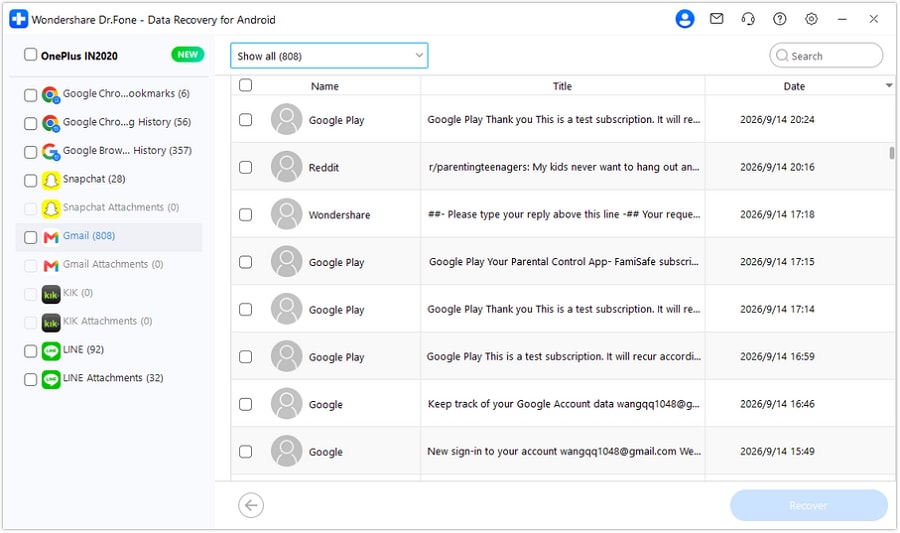
Step 4 Read the correction and inspect found audio
Choose Gmail in the results sidebar and identify candidates by name, title and date. Use search or filters where available, then read the actual content preview for the speaker correction. If Gmail Attachments contains results, inspect the real audio or other files separately, not just filenames or remote links. Select the useful available items; Gmail size-search operators are not instructions for the product's results filter.
Step 5 Recover selected interview records to the PC
Click Recover, choose a folder on your Windows computer and complete the saving prompts. Inspect the saved output for readable correction text and usable files. This is selected PC saving, not automatic transcription or restoration of messages to the G15's Gmail Inbox.




Conclusion
A broad search can uncover the small correction, while a focused local scan can help you assess the interview material that remains discoverable. Use Dr.Fone - Data Recovery (Android) to read available Gmail previews, inspect found attachments and keep selected useful records on your PC. Download the Windows version, connect your supported Motorola G15 and start the guided Gmail recovery workflow.
FAQ
1. Can I recover deleted Gmail emails and attachments on Motorola G15?
For a supported Motorola G15, Dr.Fone - Data Recovery (Android) offers Windows Advanced Recovery to inspect available local Gmail content and found attachments and save selected results to PC. The supplied Moto G15 (lamu) record lists Kernel 6.6 and no Android-version restriction for this named model. The actual recoverable items depend on the scan.2. Does larger:10M search for a particular audio attachment size?
No. Google's operator searches emails by message size, not an individual audio attachment by a guaranteed size. A message may contain several files, and a remote recording link may be in a small email. Remove the threshold if it excludes the message you need.3. Why can I find the large interview email but not the correction reply?
A retained small text-only reply can be excluded by a size threshold, has:attachment or an uncertain filename. Search the real sender across Gmail without those requirements and read the actual content. This finds retained mail; it does not restore deleted email.4. Does a found recording supply a transcript or prove all of the interview was recovered?
No. Inspect the actual found file and saved output for usable playback and the content you need. This workflow does not promise transcription, original-quality reconstruction or a complete interview based only on a filename.5. Can the scan recover discarded drafts from Gmail Trash or extend its deadline?
No. Discarded drafts cannot be recovered from Trash. Ordinary deleted messages normally have up to 30 days from deletion unless permanently deleted earlier. The local scan is a separate PC-saving route, not a reversal of Google server-side permanent deletion or an Inbox restore.
 Add Wondershare Dr.Fone as a preferred source on Google





