 Recover photos, messages, WhatsApp, and more — no backup
needed.


 100% Security Verified | No Subscription Required | No Malware


 :

 ChatGPT
 Perplexity
 Gemini
 Claude
 Grok
You emailed a manuscript to an editor, then deleted the correspondence from Gmail on your POCO F8 Pro. Now you cannot find the attached work or tell whether the submission reached the intended address. A message you sent, an automated delivery failure and an editor's response answer different questions; recovering one should not be mistaken for recovering all three.
Dr.Fone - Data Recovery (Android) helps you inspect available local Gmail records and attachment data on a supported phone, preview what is actually present and save selected results to your PC. To recover deleted Gmail emails on POCO F8 Pro, use that focused recovery route alongside mailbox checks that distinguish a missing manuscript from a delivery problem.
In this article
Before you start
Check the specific POCO F8 Pro conditions
The confirmed recovery listing names POCO F8 Pro with Android 15 and Kernel 6.6.77. Check your actual model and software against that entry. It is not a blanket listing for every POCO phone, and it is not an instruction to flash or downgrade the device.
Prepare Windows without disturbing Gmail's local data
Advanced Recovery is Windows-only. Use a Windows PC, a reliable USB data cable and a folder for the selected output. Keep Gmail's installation and account data intact: do not clear storage, remove the account, reinstall the app or reset the phone to troubleshoot recovery. Follow product access prompts without inventing a Root or bootloader procedure; lossless access is not guaranteed.
Separate the document, submission record and delivery outcome
Write down the intended editor address, approximate send date, manuscript title and any remembered filename. Dr.Fone's results can be reviewed using the names, titles and dates actually shown, with other clues checked in available content. A Google account does not guarantee local recoverable data. Selected PC records are not a server delivery log, an Inbox reconstruction, a guaranteed complete body or a promise of every attachment.
Check the manuscript email and delivery notice separately
This prevents a missing submission record from being confused with a message that failed to reach its recipient.
Step 1 Search the account used to submit the work
Confirm the email address selected in Gmail. In Search in mail, use the manuscript title or another distinctive phrase. Use the To chip for the intended editor address when looking for outgoing correspondence, and remove restrictive Date chips if the send date is uncertain.
Step 2 Look for a retained delivery failure notice
Google says failed delivery can produce an automated email from Mail Delivery Subsystem, with the address mailer-daemon@googlemail.com and a subject often reading Delivery Status Notification (Failure). Search for the notice and inspect Inbox and Spam. Read the actual error and affected address rather than treating the subject as proof that the manuscript was received.
Step 3 Extend the search to other retained locations
Open Menu > All mail for archived correspondence and search in:anywhere with relevant words to include Spam and Trash. If the online mailbox has the record but the phone does not, check the internet connection, swipe down in the Inbox to refresh and inspect Menu > Settings > your account > Sync Gmail. Offline searches include only synced messages.
Step 4 Inspect the existing manuscript source
If you still have a separately saved manuscript file, open that retained copy and compare its content with the work you intended to submit. If an actual editor reply remains, read it as its own source. A source document establishes what you possess, while an outgoing record, failure notice and editor reply each provide different correspondence context.
- A failure notice may describe a mistyped address, a temporary recipient problem or another delivery issue. Use the actual error to decide the next action; recovery software does not repair delivery.
- Do not resend automatically just because you find a submission record. First verify the destination and current submission instructions so that a recovery task does not create an unnecessary duplicate submission.
Recover a submission email retained in Trash
The outgoing correspondence, a received failure notice or an editor reply may still be present after an accidental deletion.
Step 1 Find the exact retained message
Tap Gmail Menu > Trash and inspect candidate contents to identify whether each is the submission, failure notice or response. The retention window is up to 30 days after deletion, not after the manuscript's creation or the original send date.
Step 2 Move the selected message out of Trash
Touch and hold the wanted email, tap More > Move to and choose the desired destination. Check the actual message and files that remain accessible. Do not empty Trash while investigating. Permanently deleted messages and deleted drafts cannot be restored through this procedure.
- Restoring a retained mailbox record is distinct from checking the phone's discoverable local Gmail data with Advanced Recovery.
What each recovered submission item can tell you
| Item actually available | Useful question it may answer | What it does not establish |
|---|---|---|
| Outgoing manuscript correspondence | What text or recipient information is actually visible in that record? | Successful delivery, reading or editorial acceptance. |
| A delivery failure notice | Which address and delivery error does the actual notice identify? | That the manuscript was accepted or that every intended recipient had the same outcome. |
| An editor's reply | What did the editor actually say about the submission? | The contents of an attachment that is absent from the reply. |
| A manuscript file in attachment results | Is the readable work you need present in this actual file? | That this was the exact copy delivered to the editor. |
| Only a matching title and date | Which candidate should you inspect next? | A complete manuscript, full email body or delivery confirmation. |
Common problems and fixes
A recovered submission record exists, but you still cannot confirm delivery
Inspect any available failure notice or actual editor response as a separate source. A local outgoing record is not a delivery receipt. If those sources do not settle the question, verify with the editor through an appropriate contact route before assuming the work was received or sending another copy.
The delivery notice names only one problematic address
Read the actual affected-recipient and error details. Do not apply a single address's failure to every person mentioned in the correspondence. If a replacement send is necessary, verify the specific destination and the publisher's current instructions.
The title was recovered, but the manuscript file is still missing
Inspect Gmail Attachments when attachment data is available, then open the selected PC output to check the actual work. The title is an identification clue, not the document. Use any independently retained source file if one exists, keeping it distinct from what was found in the scan.
How to use Dr.Fone - Data Recovery (Android)
Dr.Fone - Data Recovery (Android) makes the local recovery task more purposeful by letting you inspect available Gmail records and found attachments before choosing what to keep. Its Windows-only Advanced Recovery workflow can help you look for the submission context, a relevant notice or the manuscript file on a supported connected POCO F8 Pro. Preview and selective PC saving let you preserve useful material without confusing record recovery with proof of delivery.
- Identify candidate correspondence using the visible Gmail result names, titles and dates.
- Preview available content to distinguish a submission record, delivery notice and actual response.
- Review found attachment data separately and save selected records or files to a PC for inspection.
 Scan Android phones and tablets directly.
- Preview and recover only what you want.
- Supports WhatsApp, photos, videos, contacts, and more.
- Works with 6000+ Android devices.

Follow the official Advanced Recovery workflow
Step 1 Launch Advanced Recovery and connect the POCO F8 Pro
On Windows, launch Dr.Fone and open Toolbox > Data Recovery. Choose Android > Recover Android Data, select Advanced Recovery and click Start Scan. Connect the phone with USB when prompted and follow the instructions until device detection completes.

Step 2 Select Gmail data for scanning
Choose Gmail from the available app-data categories and click Start Scan. This focuses the recovery search on the local Gmail source relevant to the manuscript correspondence.

Step 3 Keep the USB connection stable
Allow the scan to proceed while the phone remains connected. If you need to stop, click Cancel before unplugging it. If the phone is temporarily unresponsive after scanning or recovery, use the restart instruction displayed by the product.

Step 4 Preview submission records, notices and available files
Choose Gmail in the results sidebar and review the names, titles and dates shown. Use search or filters where available, then inspect the actual available content of likely records. If attachment data is found, check Gmail Attachments separately for the manuscript or other useful files. Select only results you can identify from what is actually offered.
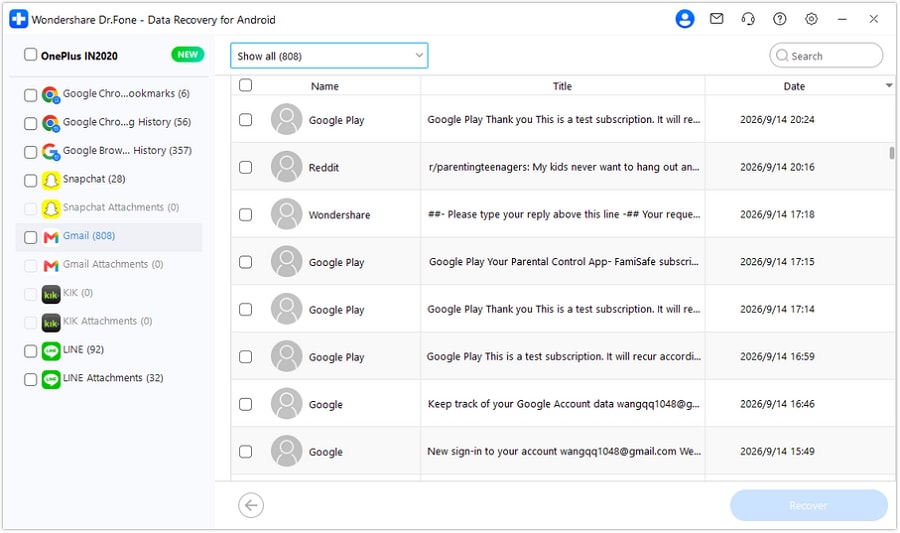
Step 5 Recover the selected Gmail material to a PC
Click Recover and follow the prompts to select a computer folder. Save the selected results and inspect the output to see which correspondence and document content is available. The mode saves a PC copy, not a reinstated Gmail message or a server delivery report.




Conclusion
A recovered manuscript file and a useful correspondence record can help you continue the submission process with better information. Dr.Fone - Data Recovery (Android) brings focused local Gmail scanning, actual-result preview and selective PC saving to a supported POCO F8 Pro. Download Dr.Fone for Windows and start reviewing the available emails and attachments that matter to your missing work.
FAQ
1. How do I recover deleted Gmail emails on POCO F8 Pro?
Check the sending account, search for the specific correspondence and inspect All mail and Trash. For a local scan, use Dr.Fone - Data Recovery (Android) on Windows with the listed Android 15 and Kernel 6.6.77 conditions, preview available Gmail results and save selected records to a PC.2. Does recovering a sent submission prove the editor received it?
No. A local outgoing record is not proof of delivery, reading or acceptance. Read any actual delivery error or editor reply separately, and contact the editor if the remaining evidence does not establish the outcome.3. Can I recover deleted Gmail attachments on POCO F8 Pro even if the delivery failed?
Delivery outcome and local file availability are different questions. If Advanced Recovery finds usable attachment data, inspect Gmail Attachments and save the wanted item. A failed delivery notice alone does not establish that the manuscript file exists locally or was found by the scan.4. Where should I look for a Gmail delivery failure notice?
Google advises checking Inbox and Spam for a Mail Delivery Subsystem email, often titled Delivery Status Notification (Failure). If you may have deleted it, also inspect Trash or use in:anywhere in Gmail. Read the actual error and affected address.5. Does Dr.Fone resend the recovered email or restore Google's permanent deletion?
No. This Windows-only workflow saves selected discoverable phone-local Gmail results to a PC. It does not send mail, change delivery status, recover permanently deleted Google server mail or put messages back into the Inbox.
 Add Wondershare Dr.Fone as a preferred source on Google





