Recover photos, messages, WhatsApp, and more — no backup
needed.


 100% Security Verified | No Subscription Required | No Malware

 :

 ChatGPT
 Perplexity
 Gemini
 Claude
 Grok
You joined a community project group, received the starter instructions, then accidentally deleted the conversation on your Galaxy S24. The group is still familiar, but the file naming rule, submission contact and example photos are missing. If you need to recover deleted LINE messages on Samsung Galaxy S24 without a backup, finding the group is only part of the problem: you need the actual instructions you once received.
Dr.Fone - Data Recovery (Android) offers a focused way to look for that missing LINE data on a supported phone. You can preview available conversation records, inspect the attachment results and save selected useful material to your PC. Before scanning, establish whether the instructions were received and deleted or were posted before you became a member; the next action is different.
In this article
Before you start
Check the Galaxy S24 and its listed Kernel
The confirmed record for Samsung Galaxy S24 lists Kernels 6.1.99, 6.1.128, 6.1.145 and 6.1.157. No Android-version restriction is listed for this model; the named-model and Kernel conditions still apply. In the phone's Settings, use About phone and Software information to note its identity and Kernel version. These conditions do not establish support for other Galaxy models or guarantee particular messages.
Preserve the phone and prepare Windows
Advanced Recovery is Windows-only. Have a Windows PC, a USB data cable and a private destination folder ready. Keep LINE installed, and do not clear its storage or cache, reset the phone, unlock its bootloader or flash firmware as a recovery experiment. Follow Dr.Fone's displayed connection and access prompts; this guide does not prescribe an unverified Root procedure.
Identify the period and the information you received
Note approximately when you joined, when the starter message arrived and what you need: the written submission rule, a reference image, a video demonstration or a file. Recoverable items are those found by the scan. The selected output goes to a PC, not back into the LINE group's history.
Check whether the missing instructions predate your group membership
Use this check when the group is visible but its older discussion seems absent, or an invitation has been mistaken for a copy of the group's history.
Step 1 Separate an invitation from actual membership
If joining required approval of the invitation, check whether you actually selected Join. On a main device in Japan, Taiwan or Thailand, LINE lists invitations under Chats > Friends > Groups > Group invitations; outside those regions, use Home > Groups > Group invitations. Inspect the relevant invitation without leaving or recreating a group.
Step 2 Look for retained instructions from after you joined
Open the existing group chat and use its search icon for a distinctive phrase such as the project name or submission label. The in-chat calendar search can help locate messages around your joining date. Open the group's existing Notes or Albums if the organizer says the starter material was posted there; those are shared posts, not copies of every chat message.
Step 3 Ask for the specific earlier material when needed
LINE states that new members cannot see chat messages posted before they joined, although Note and Album posts from the pending-membership period can be visible after joining. Ask an existing member to resend the particular instructions and examples if those messages were never in your history. If you received the instructions and later deleted them, use the device-scan workflow below.
- A pending-member entry does not prove that the person joined; LINE can continue showing a declined invitation as pending.
- Do not leave and rejoin to retrieve history. A new invitation is an access route, not a way to restore previously deleted messages.
Turn group-history results into a usable starter reference
| What you find | Useful information to keep | What to check next |
|---|---|---|
| A received starter message | The actual submission label, contact and procedure | Read its date and any later correction before following it. |
| An existing group Note | The instructions currently posted on the shared board | Ask whether it replaced the older chat instructions; do not assume unchanged wording. |
| A photo, video or document in LINE Attachments | The example or reference file that is actually available | Match its visible content with the written rule rather than choosing by thumbnail alone. |
| A member's newly resent instructions | A practical copy you can use now | Keep its new sending date separate from any recovered original message. |
Common problems and fixes
The group is present, but none of the pre-joining messages appear
That is consistent with LINE's joining rule, not evidence that your Galaxy S24 lost those messages. Request the earlier material from a member who actually retains it. Focus a scan on content that was present on your own phone rather than expecting it to retrieve other members' private histories.
A sample image is available, but its submission instructions are missing
Save the useful image if it is accessible, then review the LINE conversation results for the associated wording. A photograph of the finished example may not show the required filename, recipient or submission process. Mark any unresolved detail and ask the organizer for current instructions instead of inferring it from the image.
Advanced Recovery is not offered for the connected phone
Check that you are using Windows and compare the actual Galaxy S24 Kernel with the listed conditions. Keep the product's message and your device details for Dr.Fone support. Do not change firmware or Root settings merely to make the recovery option appear.
How to use Dr.Fone - Data Recovery (Android)
Dr.Fone - Data Recovery (Android) gives you a no-backup device-scan route for missing LINE instructions on a supported Galaxy S24. Its Windows-only Advanced Recovery workflow lets you inspect available conversation records and attachments, then save the selected results to a PC. This is useful when you want the received wording and its example file together, rather than only a group invitation or a familiar thumbnail.
- LINE conversation preview helps you identify received instructions and any available follow-up corrections.
- The separate LINE Attachments view lets you inspect available photos, videos and files before selecting them.
- Selective PC recovery lets you keep the relevant starter material without saving every unrelated group discussion.
 Scan Android phones and tablets directly.
- Preview and recover only what you want.
- Supports WhatsApp, photos, videos, contacts, and more.
- Works with 6000+ Android devices.
Follow the official Advanced Recovery workflow
Step 1 Open Advanced Recovery and connect the Galaxy S24
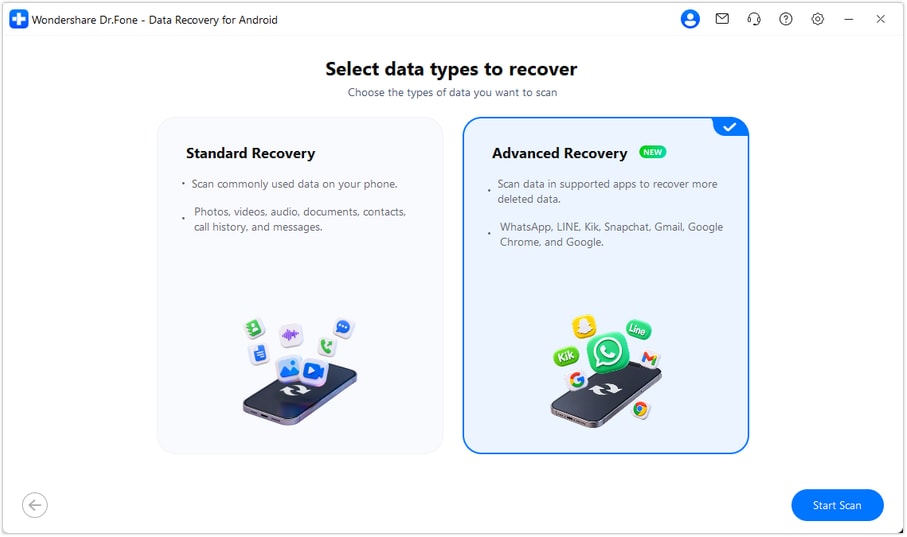
Launch Dr.Fone on Windows and select Toolbox > Data Recovery > Android > Recover Android Data. Choose Advanced Recovery and click Start Scan. Connect the supported Galaxy S24 with a USB data cable when prompted and complete the on-screen device-detection instructions.
Step 2 Select LINE as the app data to scan
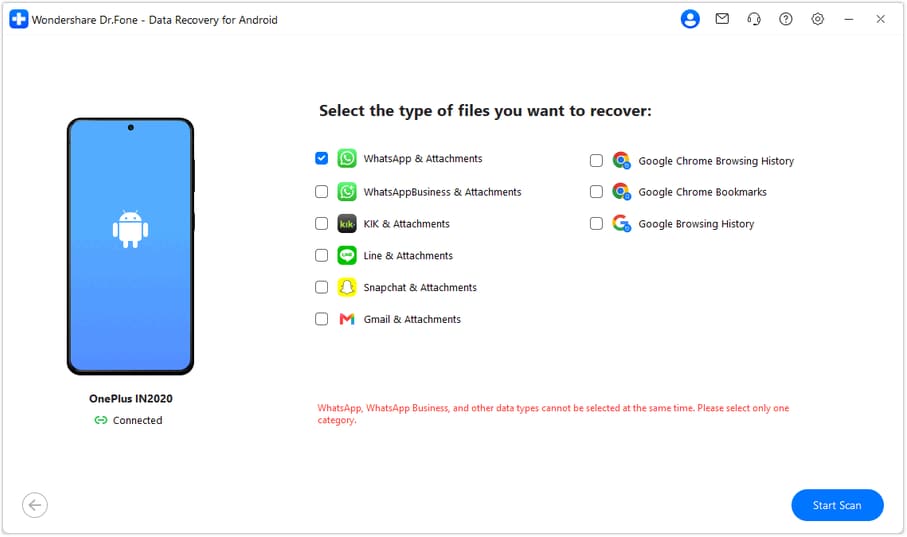
Choose LINE from the available app-data categories and click Start Scan. For this task, keep your attention on the LINE data containing the group instructions and associated files.
Step 3 Keep the phone connected during the scan
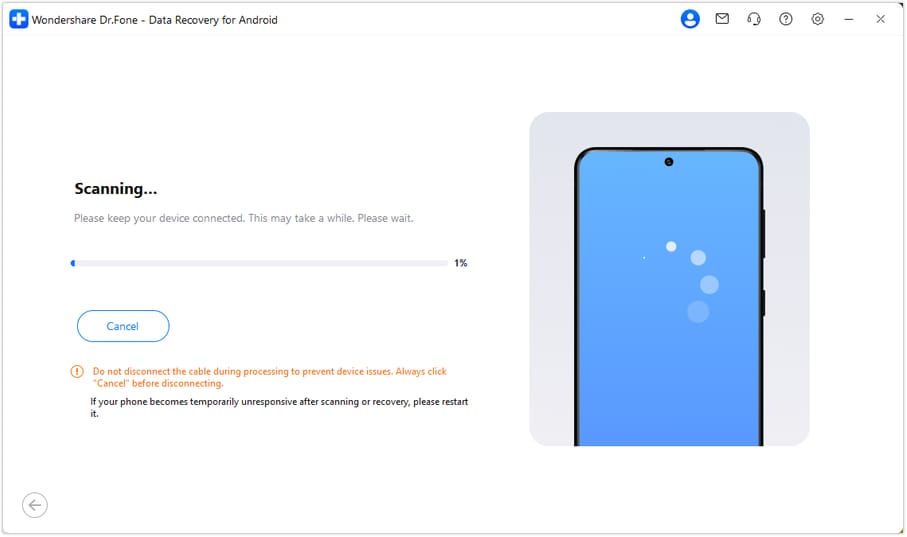
Allow Advanced Recovery to scan while the USB connection remains stable. If you need to stop, click Cancel before disconnecting. If the phone is temporarily unresponsive afterward, use the restart instructions displayed by the product.
Step 4 Preview the group conversation and its attachments separately
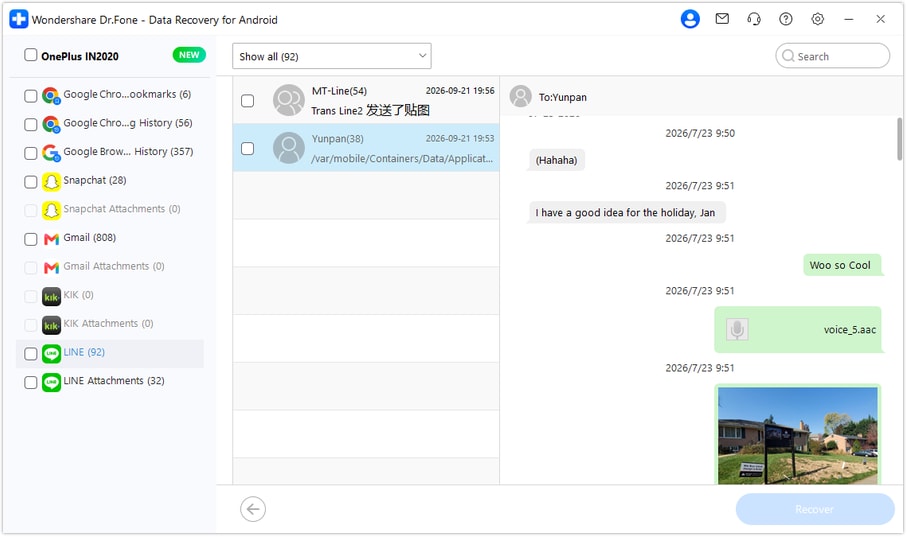
Choose LINE to review available conversations and look for the received starter instructions. Use search or filters where offered. Then choose LINE Attachments to inspect available example images, videos and documents. Select the records that match the instructions you need.
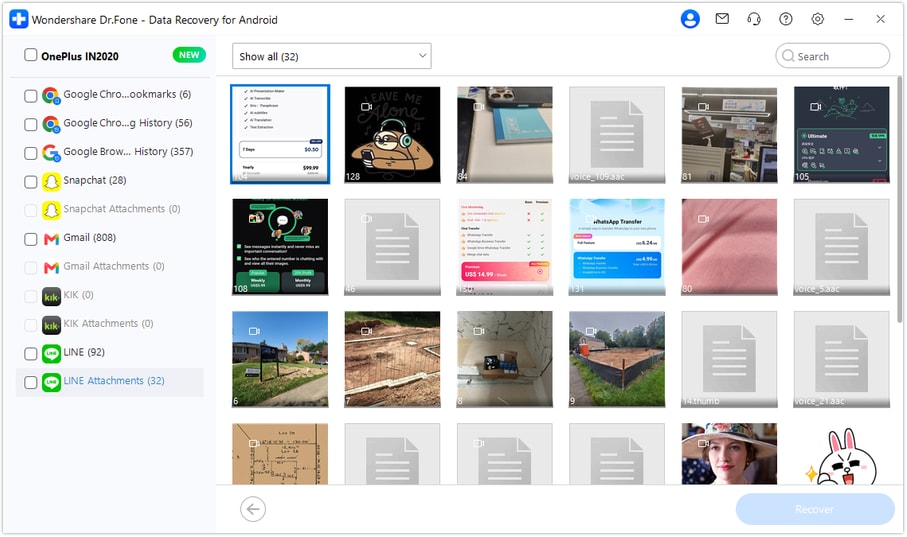
Step 5 Save selected LINE results to your computer
Click Recover, choose a folder on your PC and complete the save prompts. Open the saved output and check the wording and usable files. Keep any newly supplied current instructions separately; Advanced Recovery saves a PC copy rather than importing a history into LINE.




Conclusion
For instructions you received and then deleted, Dr.Fone - Data Recovery (Android) provides a practical next step beyond requesting another group invitation. Preview discoverable LINE conversations, inspect the available example files and preserve selected material on your PC. Download Dr.Fone for Windows, connect your supported Samsung Galaxy S24 and start the guided scan to look for the instructions that help you get moving again.
FAQ
1. Can I recover deleted LINE messages on Samsung Galaxy S24 without a backup?
Dr.Fone - Data Recovery (Android) can scan a supported Galaxy S24 without relying on an earlier LINE backup. Use Advanced Recovery on Windows, inspect the available LINE and LINE Attachments results and save the selected records to a PC. What you can recover depends on what the scan finds.2. Will joining or rejoining a LINE group reveal its older messages?
LINE states that users cannot see chat messages posted before they joined. Joining is not deleted-history recovery. Ask a member who retains the earlier instructions for a copy, and distinguish those messages from content you actually received before deleting it.3. Does a group invitation restore deleted LINE photos and attachments?
No. It provides group access, not restoration of the old chat or its files. Check any existing shared Note or Album that actually contains the material, or inspect available LINE Attachments results in Dr.Fone. A thumbnail alone is not a usable original.4. Could Standard Backup or Premium Backup recover this deleted group discussion?
Standard Backup is text-focused and requires the relevant messages to have been backed up before deletion. It is not a solution when no such backup exists. LINE also says Premium Backup cannot restore manually deleted chat history; it should not be treated as a historical rollback feature.5. Should I look on a linked PC for a complete group backup?
Do not assume it is an independent full backup. Deleting a whole chat can affect the same account's other devices. If a separate participant still has a message, their retained copy can help, but it is not the same thing as restoring your original local history.
 Add Wondershare Dr.Fone as a preferred source on Google