Effortlessly manage data through preview, delete, export, etc.

 100% Security Verified | No Subscription Required | No Malware

 :
: 
 ChatGPT
 Perplexity
 Gemini
 Claude
 Grok
Grok

I can keep my work moving on my phone, tablet, and laptop—until one tiny sync setting is wrong. Then calendars drift, files duplicate, and I realize too late I overwrote the “good” version.
Forum user
Building a consistent business routine across phone, tablet, and computer is easy to start—and surprisingly easy to break if you miss one dependency (like where the “source of truth” actually lives). AI can help you map the workflow, put steps in the right order, and add verification checkpoints so you don’t discover gaps only after a missed call, lost file, or overwritten calendar.
In this article
- How to plan a cross-device business routine without losing work
- Why “sync everything” fails
- Where routines break in real life
- Irreversible actions to avoid too early
- What a safe plan must include
- What the AI needs to know
- AI prompts: Level 1–3 + refinement
- AI plan vs. real device constraints
- When to stop planning and start execution
Part 1. How to plan a cross-device business routine without losing work

You’re trying to keep the same business day moving across devices: calls and messages on your phone, notes and reading on a tablet, files and invoicing on a computer. The goal isn’t “sync everything”—it’s a repeatable routine that prevents conflicts and avoids losing time.
The uncertainty usually starts after you ask AI “what should I do?” and you get a list of apps and vague advice—but not a concrete sequence. You still don’t know what to do first, what to verify, and what to do when devices disagree.
The point-of-no-return moment often arrives quietly: you select “Replace/Overwrite data”, factory reset, or delete duplicates during cleanup or migration. If you reach that step before verifying your backups and your “source of truth,” recovery may be partial or impossible.
Part 2. What the AI needs to know
Share your current setup and what “done” looks like, so the plan can be sequenced and verified.
- Devices and OS versions (e.g., iPhone iOS 17, Android 14 phone, iPadOS 17, Windows 11, macOS 14)
- What “business routine” includes (calls, SMS/WhatsApp, email, calendar, contacts, notes, documents, photos, recordings, scanned receipts)
- Which apps/services are involved (e.g., Gmail/Outlook, Google Calendar/Apple Calendar, iCloud/Google Drive/OneDrive, Notion/Evernote, WhatsApp/Teams/Slack)
- Where the current source of truth is for each data type (phone vs. cloud vs. computer)
- What must be available offline (and on which device)
- Security requirements (2FA, password manager, encryption needs, compliance constraints)
- Your tolerance for change (keep current apps vs. willing to switch)
- Timing constraints and downtime window (e.g., “can’t miss calls 9am–6pm”)
- Risk constraints (cannot lose chat history, cannot lose contact groups, must preserve photo metadata)
- What you’ve already tried (sync toggles, exports, cable transfer, cloud restore)
Part 3. AI prompts: Level 1–3 + refinement
Use the prompts below to force a structured plan with checkpoints before any irreversible action.
3-1. Level 1: Basic Prompt
Create a step-by-step plan for a consistent business routine across my phone, tablet, and computer.
Include the correct order of operations and a short checklist to confirm each step worked before moving on.
Do not include any execution—planning and verification only.
3-2. Level 2: Advanced Prompt
Design a structured workflow for my business routine across phone, tablet, and computer with three phases: Preparation, Execution, and Verification.
In each phase, mark steps as Critical or Optional, and highlight any step that could cause data loss (overwrite, delete, reset) with a “Stop and verify” checkpoint before it.
3-3. Level 3: Evidence Prompt
I have (Android phone), (iPad), and (Windows 11 laptop).
My routine needs: calls/SMS, WhatsApp history, contacts, calendar, email, scanned receipts, and shared project files (e.g., OneDrive “Client-Projects” folder).
Build a workflow that specifies:
- For each data type, define source of truth, sync direction, and failure signals (e.g., “contacts count differs by >5%”).
- Checks before, during, and after execution, including what screenshots/logs/exports I should collect as evidence.
- A “no-return” list of actions I must not do until verification is complete (e.g., factory reset, enabling “replace on device,” deleting duplicates).
Keep it planning-only; I will use a device tool to execute later.
3-4. Prompt Refinement (follow-ups)
If the first answer is still too generic, run these follow-ups one by one.
Convert the workflow into a table with columns: Data type, Source of truth, Where it must appear, Sync method, Pre-check, Post-check, Rollback option.
Add exact pass/fail criteria for each verification step (counts, timestamps, sample spot-checks), and define what to do if a check fails.
List the top 10 ways this workflow can go wrong on real devices (permissions, low storage, duplicate merges, outdated OS, account mismatch) and add preventive steps.
Rewrite the plan assuming I only have a 60-minute window and cannot risk missing calls; identify what to postpone and what to protect first.
Part 4. AI plan vs. real device constraints
| AI can plan and clarify | Real device constraints you must handle |
|---|---|
| Define sequence and dependencies across devices | Devices may have different accounts signed in or partial sync enabled |
| Create verification checklists and pass/fail criteria | Sync status can appear “complete” while some items are missing or delayed |
| Identify high-risk steps (overwrite/delete/reset) and add stop points | One wrong choice during transfer/restore can overwrite existing data |
| Propose rollback/backup strategy | Storage limits, cable issues, permissions, and encryption can block backups/transfers |
AI improves planning and risk control, but it cannot read your device state or perform the operations; you still need to execute with real tools and confirm results on the devices.
Part 5. When to stop planning and start execution
- You can name the source of truth for each data type (contacts, calendar, chats, files) and it’s consistent with your accounts.
- You have a written no-return list (overwrite/replace, delete duplicates, reset) and clear “stop and verify” gates before each.
- You have a backup/rollback path for the items you cannot recreate (e.g., chats, contacts, photos, receipts).
- Your verification checks are measurable (counts, spot-check items, timestamps) and you know what failure looks like.
Once these are true, planning should pause so you don’t endlessly revise the plan while your real data keeps changing.
Execute the Workflow Safely with Dr.Fone
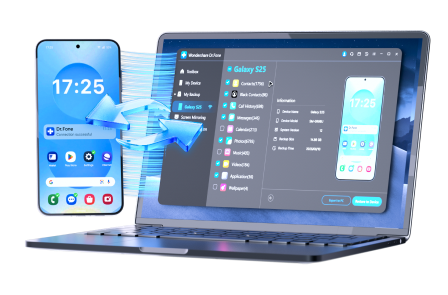
Execution now matters because the plan only becomes real when your devices complete backups/transfers without conflicts—and you confirm the results before any cleanup or overwrite decisions. If you also need a reliable way to keep work moving across screens during the day (for example, viewing phone calls/messages on a larger display), Dr.Fone Basic - Screen Mirroring can help you mirror your device to a computer while you follow the routine you planned.
 Easily manage data through preview, delete, export, etc.
- Transfer all data between devices.
- Robust backup solutions for reliable data protection.
- Mirror screens to PC for meetings, teaching, and control.
Use your AI plan as the checklist, then execute carefully with real device tools:
- Create a protected baseline (backup first): perform the backup step(s) you planned so you have a rollback point before any migration or cleanup. AI cannot verify the backup actually contains the needed items or that it’s readable; you must confirm on your computer and devices.
- Run the planned transfer/sync sequence (no cleanup yet): carry out the steps in the exact order from your plan, avoiding any “replace/overwrite” options until verification passes. AI cannot see prompts on your screen or prevent a wrong click; you must pause if any option implies deletion, merge, replace, or reset.
- Verify outcomes, then lock the routine: only do the final planned actions after you confirm counts, samples, and timestamps match your pass criteria across devices. If verification is unclear, stop before any irreversible cleanup.
-
Step 1 Start the mirroring flow on your computer
Open the mirroring feature on your computer and select the wireless mirroring option so you can follow on-screen pairing instructions.

-
Step 2 Prepare your phone/tablet for pairing
On your mobile device, enter the mirroring mode shown by the tool (ensure Wi‑Fi is stable and required permissions are allowed).

-
Step 3 Scan the QR code to connect
Use your phone/tablet to scan the QR code displayed on your computer to establish the connection.

-
Step 4 Confirm the device is mirrored, then proceed with verification
Once the screen is mirrored, continue your routine while you run the verification checks (counts, timestamps, spot-check items) from your plan.




Conclusion
Use AI to design the sequence, define “source of truth,” and build verification gates; then use Dr.Fone to execute the backups/transfers on real devices—only after your plan is specific enough to avoid irreversible mistakes.
FAQ
-
What’s the biggest risk when making a routine work across phone, tablet, and computer?
Accidentally creating two “sources of truth,” then overwriting good data with incomplete data during a restore/transfer or a duplicate-merge. -
How do I know I’m about to do something irreversible?
Any step that mentions replace, overwrite, erase, reset, remove duplicates, merge contacts, or restore backup to device can permanently change data—treat it as a stop point. -
What should I verify before I transfer anything?
Accounts signed in on each device, available storage, and baseline counts (contacts, calendars, photos/files), plus a backup/rollback path for non-recoverable items like chats. -
When should I run the execution—during or after a workday?
When you can tolerate interruptions and delays, ideally in a downtime window with charging, stable cable/Wi‑Fi, and time to verify without rushing. -
Can AI tell me if my devices are truly synced?
No. AI can define what to check (counts, timestamps, spot-check items), but only you can confirm the real device state.
 Add Wondershare Dr.Fone as a preferred source on Google