Effortlessly manage data through preview, delete, export, etc.

 100% Security Verified | No Subscription Required | No Malware

 :
: 
 ChatGPT
 Perplexity
 Gemini
 Claude
 Grok
Grok

We tried to pick the “best” location-based demo setup, but every option broke in a different way once reps got into real venues—offline moments, indoor GPS issues, and updates nobody pushed on time.
Forum user
Choosing between different location-based tablet demo scenarios is rarely about what’s “best,” and more about what will hold up in your real selling or training environment. Generic answers miss the constraints that actually make demos succeed or fail.
AI can help by turning fuzzy preferences (“needs to be impressive,” “must work offline,” “easy for reps”) into explicit trade-offs, ranked by what you value most. That makes the choice feel less like guessing and more like selecting a designed outcome.
AI can’t verify hands-on friction: GPS reliability in your venues, staff behavior under pressure, or whether your content updates process will break at week three. After you decide, the practical work—setup, transfer, cleanup, and device readiness—still determines whether the plan works.
In this article
- How to compare location-based tablet demo scenarios based on real priorities
- Three common approaches
- Wow factor vs operational reliability
- What you’re optimizing for
- How to frame trade-offs
- What the AI needs to compare
- Using AI prompts to evaluate more clearly
- When to stop researching and make the call
- After choosing: switch or prepare smoothly with Dr.Fone
Part 1. How to Compare plan location based tablet demo scenarios Based on Real Priorities
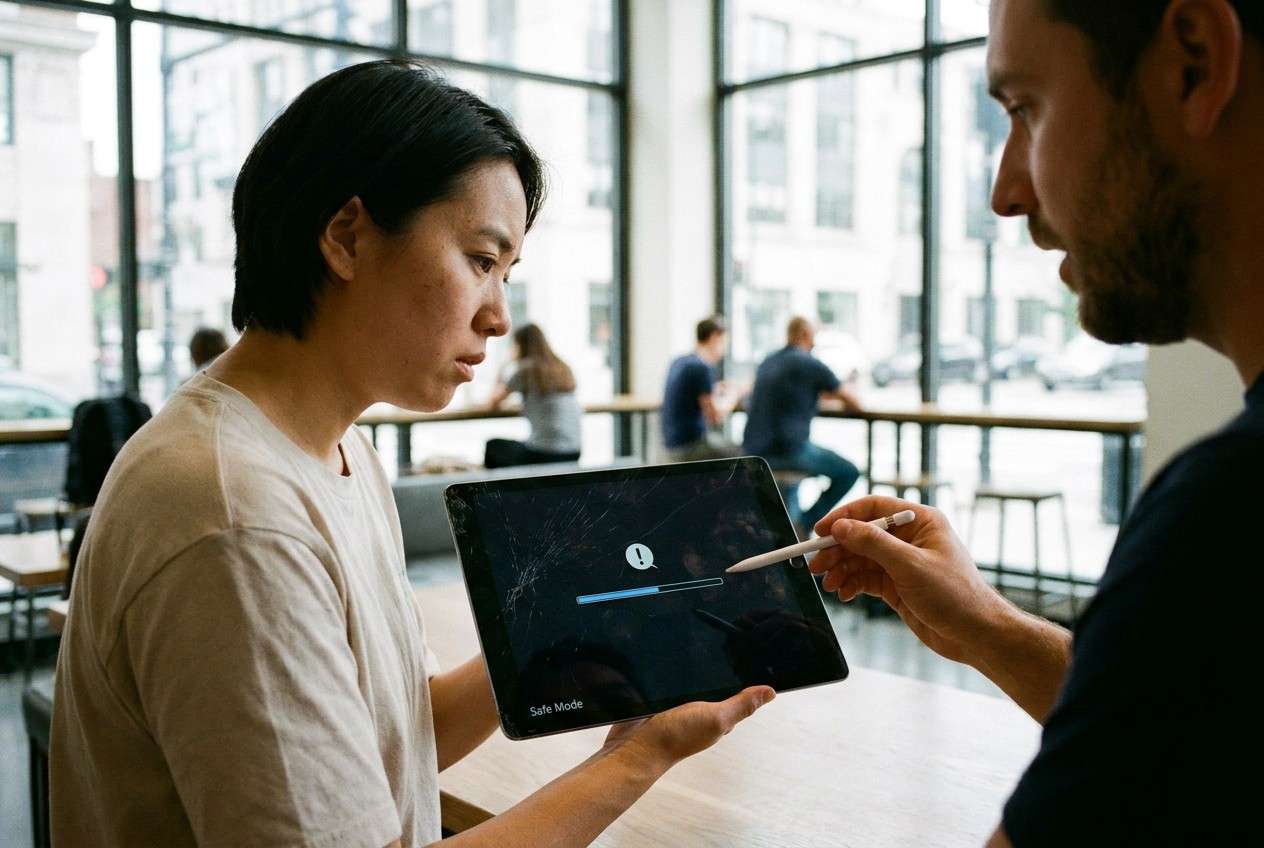
Most teams end up choosing between three common approaches: a single reusable “generic” demo, multiple location-specific demo variants, or a truly location-aware demo that changes content automatically by where the tablet is used. Each can be right—depending on your rollout reality.
The tension is usually between wow factor vs operational reliability. The more dynamic and location-aware you go, the more you risk edge cases (permissions, weak GPS indoors, content mismatches) that can derail a live moment.
A better comparison is to decide what you’re optimizing for: consistency across reps, speed of deployment, compliance/privacy, offline resiliency, or tailoring the story to each venue.
Part 2. What the AI Needs to Compare
Provide these details so the AI can compare scenarios based on your real constraints instead of generic “feature” talk:
- The options you’re considering (e.g., generic, location-specific variants, GPS-triggered dynamic)
- Where demos happen (indoors retail, outdoor sites, trade shows, client offices) and how predictable those locations are
- Connectivity reality (reliable Wi‑Fi, cellular only, often offline)
- Who runs the demo (sales reps, trainers, kiosk/self-serve) and their tolerance for troubleshooting
- Update workflow (how often content changes, who publishes, how fast fixes must ship)
- Risk constraints (privacy/location permissions, client policies, brand/compliance requirements)
- Success definition (conversion, time-to-first-demo, reduced training time, fewer failed sessions)
- Scale (number of tablets, locations, languages, and how quickly you must roll out)
Part 3. Using AI Prompts to Evaluate plan location based tablet demo scenarios More Clearly
Use these prompts to force a trade-off decision instead of a vague “comparison.”
3-1. Level 1: Basic Prompt
I’m choosing between these plan location based tablet demo scenarios: (A) generic demo, (B) location-specific variants, (C) GPS-triggered dynamic demo.
Compare them for reliability, maintenance effort, and demo effectiveness, and tell me which is safest vs which is most persuasive.
3-2. Level 2: Advanced Prompt
Act as a decision assistant.
Compare (A) generic demo, (B) location-specific variants, (C) GPS-triggered dynamic demo using my priorities: [rank your top 5 priorities] and constraints: [offline needs, who runs it, update frequency, privacy limits].
Make the trade-offs explicit and tell me who each option fits better (small team vs large rollout, high-compliance vs flexible, indoor vs outdoor, tech-savvy reps vs low-support environments).
3-3. Level 3: Evidence Prompt
Here’s my context: [where demos happen], [connectivity], [number of tablets/locations], [who runs it], [how often content changes], and [what “success” means].
Recommend one scenario approach: generic, location-specific variants, or GPS-triggered dynamic.
For each option, clearly state what we gain / what we give up, and identify one key assumption that—if wrong—would flip your recommendation.
3-4. Prompt Refinement
If our demos fail 1 out of 20 times due to location detection or setup confusion, which option becomes too risky—and why?
What is the most likely regret 60 days after launch for each option (generic vs variants vs GPS-triggered)?
If content updates happen weekly instead of monthly, how does that change the best choice?
Assume the demo is mostly indoors with spotty GPS.
Redo the recommendation and explain what breaks first.
Which option minimizes “tribal knowledge” (only one expert knows how it works) and why?
What’s the smallest pilot that would validate the risky assumptions for the top recommendation?
3-5. AI Recommendation vs Real-World Fit
| Likely AI recommendation or conclusion | What real-life use may change or reveal |
|---|---|
| “Choose generic if reliability and speed matter most.” | Reps may find it too generic, leading to weak engagement or longer explanation time. |
| “Choose location-specific variants if you need relevance without complex automation.” | Your update workflow may become the bottleneck (version drift, wrong variant on the wrong tablet). |
| “Choose GPS-triggered dynamic if you need a ‘wow’ experience and high contextual fit.” | Indoor GPS, permissions prompts, or location inaccuracies can cause awkward live failures. |
| “Hybrid approach (manual location selection + light location cues) is the safest compromise.” | Users may still skip the selection step, or choose the wrong location under pressure. |
AI can clarify likely fit, but hands-on use, workflow friction, and daily habits still decide satisfaction.
Part 4. When to Stop Researching plan location based tablet demo scenarios and Make the Call
- You can state your top priority in one sentence (e.g., “Never fail live,” “Tailored story per site,” or “Fast rollout with weekly updates”).
- You’ve identified the single riskiest assumption (GPS accuracy, offline readiness, update workflow, staff behavior) and have a plan to test it.
- You can explain, in plain language, what you gain and what you give up with the option you’re leaning toward.
- You’ve defined a “good enough” pilot success metric (not perfection) that tells you whether to scale.
Once you can articulate the trade-offs and the pilot test, you’re no longer researching—you’re deciding.
Part 5. After Choosing plan location based tablet demo scenarios: Switch or Prepare Smoothly with Dr.Fone
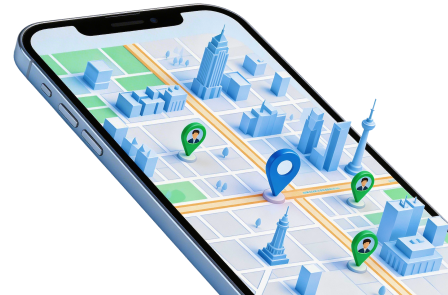
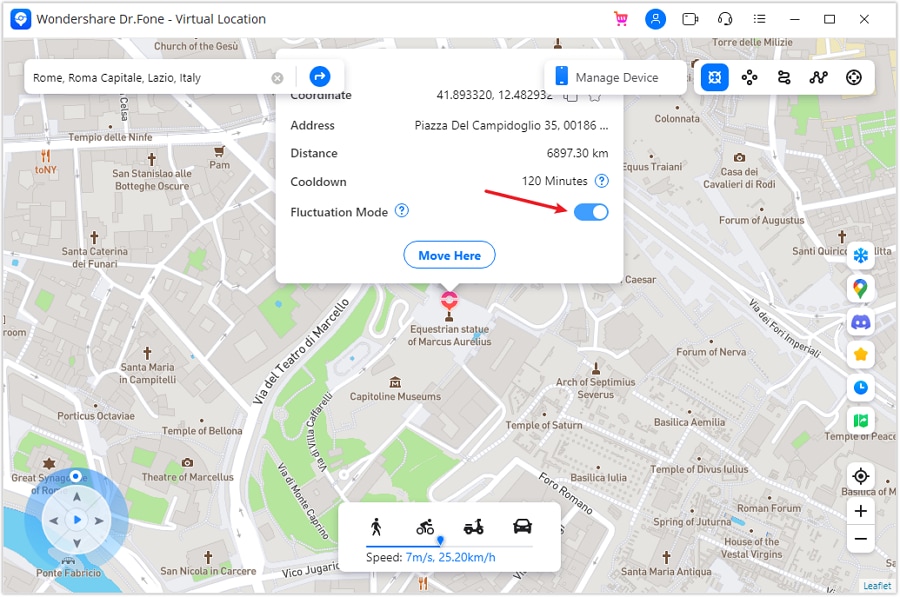
After you pick an approach, execution usually means moving content/accounts to demo devices, cleaning up old data, and preparing tablets for reliable use (or resale/rotation). Doing this cleanly reduces day-one friction. If you’re validating GPS-triggered dynamic demos in a controlled way, you may also want a way to simulate or stabilize location signals during testing—this is where Dr.Fone - Virtual Location can help.
 Set your map route to simulate GPS movement.
- Set your wanted movement speed.
- HD and large map view to check location.
- Fake GPS location to anywhere.
-
Step 1 Consolidate and transfer what the demo tablets actually need
Move essential files/data between devices when you’re setting up or rotating demo tablets, so each device starts from the same baseline.

Limitation: It won’t design your demo flow or fix weak location detection—this is device-level preparation.
-
Step 2 Back up before you standardize devices
Create a backup of key demo assets and device data so you can recover quickly if a tablet gets misconfigured during rollout.

Limitation: Backups won’t prevent process issues like outdated variants or inconsistent rep workflows.
-
Step 3 Clean up devices for kiosk-like readiness or resale
Remove leftover personal/client data and tidy devices before redeploying them to reps or preparing them for resale/rotation.
Limitation: Cleanup doesn’t replace compliance policies—you still need your organization’s approval and procedures.
-
Step 4 Validate GPS-triggered demos with safer, controlled location testing
If you’re considering a GPS-triggered dynamic demo, do a small pilot that stress-tests “what happens when location is wrong or delayed” before rolling out broadly.

Limitation: Testing tools can help simulate conditions, but they don’t replace real venue trials (indoor signal, permissions prompts, and rep behavior).




Conclusion
AI is best used here as decision support: it helps you surface trade-offs, rank priorities, and pinpoint flip-factor assumptions; real use is what proves the fit. Once you’ve chosen your scenario approach, tools like Dr.Fone help with the practical follow-through—transfer, backup, and cleanup—so the rollout is smooth.
FAQ
-
Can I trust AI to recommend the right demo scenario approach?
Trust it for structured trade-offs and highlighting risks; don’t trust it to validate venue realities like indoor GPS reliability or staff behavior under pressure. -
What’s the most important trade-off in location-based tablet demos?
Usually it’s contextual relevance vs operational reliability: the more automatic and tailored it is, the more edge cases can break live. -
How do I avoid a generic, spec-based decision?
Force the comparison around failure modes (offline, permissions, wrong content shown), update workload, and who supports reps—not hardware specs. -
What should I prepare before launching the chosen scenario?
A pilot plan that tests your riskiest assumption, a simple update workflow, and a “what to do when it breaks” script for the person running the demo. -
If we’re switching tablets or rotating demo devices, what matters most?
Consistency and cleanliness: transfer only what’s needed, back up before changes, and remove leftover data so devices behave predictably in the field.
 Add Wondershare Dr.Fone as a preferred source on Google