Effortlessly manage data through preview, delete, export, etc.

 100% Security Verified | No Subscription Required | No Malware

 :
: 
 ChatGPT
 Perplexity
 Gemini
 Claude
 Grok
Grok
What is Always-On Display on iPhone? It’s a display feature that keeps a dimmed version of your Lock Screen visible even when the phone is "locked," so you can glance at time, widgets, and notifications without fully waking the screen. It’s designed to be convenient while managing power use.
In plain English: Always-On Display (often shortened to AOD) lets your iPhone show key Lock Screen info all the time, at a lower brightness, so you don’t have to tap or raise your phone as often. One key takeaway: it’s optional and can be turned off if you prefer maximum privacy or battery life.
In this article
- Part 1. What Always-On Display is used for: core uses & scenarios (Why it matters)
- Part 2. How Always-On Display works: official working logic (How it works, non-technical + technical-lite)
- Part 3. Where to find Always-On Display: settings paths and entry points (Where to find it)
- Part 4. How to use, enable, disable, or check Always-On Display
- Part 5. Requirements and compatibility
- Part 6. Always-On Display vs related concepts
- Part 7. Common issues and misconceptions
- Part 8. Security, privacy, and compliance notes
Part 1. What Always-On Display is used for: core uses & scenarios (Why it matters)
Core uses and real-world scenarios
Always-On Display matters because it reduces "pick up and wake" moments while keeping useful info visible at a glance—without unlocking your iPhone.
- Checking the time during meetings or classes without lighting up the whole screen
- Seeing live widget info (calendar, weather, reminders) while your phone stays locked
- Glancing at notification previews (based on your notification privacy settings)
- Using the phone as a bedside clock while keeping the Lock Screen style visible
- Monitoring Focus mode status (for example, Work or Sleep) at a glance
Who needs it most
It’s most useful for everyday users who frequently check the time or widgets, and for buyers comparing iPhone models (since availability depends on hardware). People who prioritize privacy (shared spaces, commuting, workplace environments) may choose to limit Lock Screen notification content or disable AOD. Enterprise or education users may also care because visible lock-screen info can intersect with organizational privacy policies.
Part 2. How Always-On Display works: official working logic (How it works, non-technical + technical-lite)
Plain explanation
Always-On Display keeps the Lock Screen "on" in a dimmed, low-power state instead of turning the display completely off. Your iPhone reduces brightness and refresh behavior so the screen uses less power, and it can hide or dim parts of the Lock Screen depending on conditions (for example, when the phone is face down or in a pocket).
Key components
- Supported display hardware: Models with the necessary OLED/variable refresh capabilities can run AOD efficiently.
- Ambient light + proximity sensing: Helps decide when to dim further or turn the display off (for example, in a pocket or face down).
- Lock Screen system: AOD is essentially the Lock Screen rendered in a low-power state, including widgets and the clock.
- Notification settings: What you see depends on notification previews and Lock Screen privacy settings.
- Power and focus conditions: Low Power Mode, Focus modes, and system power management can change AOD behavior.
Part 3. Where to find Always-On Display: settings paths and entry points (Where to find it)
Settings or menu paths
On supported iPhone models, you can typically find it here:
- Settings > Display & Brightness > Always On Display
If you don’t see the option, it may be unavailable on your iPhone model or limited by iOS version, device management restrictions, or certain battery settings.
Search keywords and entry tips
- Settings search keyword: "Always On" or "Always-On Display"
If labels vary, look under Display & Brightness for a toggle related to keeping the Lock Screen visible when the screen is otherwise idle.
Part 4. How to use, enable, disable, or check Always-On Display
Safe how-to steps
-
Step 1 Open Settings
Open Settings on your iPhone.
-
Step 2 Go to Display & Brightness
Tap Display & Brightness.
-
Step 3 Open the Always On Display menu
Tap Always On Display (if shown).
-
Step 4 Turn it On or Off
Turn Always On Display On or Off.
-
Step 5 Confirm the behavior
Lock your iPhone to confirm the behavior matches your preference.
Official help resources
Apple’s exact support resources and wording can vary by region and iOS version, and no official URL was provided here. If you need model-specific guidance, use Apple Support search within the Apple Support app or Apple’s official support site.
Part 5. Requirements and compatibility
Quick compatibility table
| Item | What to expect on iPhone |
|---|---|
| Supported devices | Available on certain iPhone Pro models (for example, iPhone 14 Pro and later Pro models); availability varies by model and region |
| iOS requirement | Requires a compatible iOS version (commonly associated with iOS 16+ on supported hardware; exact behavior varies by iOS version) |
| Apple ID sign-in | Not required specifically for AOD, but some Lock Screen data (widgets/services) may depend on signed-in apps/accounts |
| Required toggles | Always On Display toggle (if supported) in Settings > Display & Brightness |
| Connectivity | Not required for the feature itself; some widgets/updates may depend on network access |
| Offline behavior | Clock and basic Lock Screen remain visible; some dynamic content may not update without connectivity |
| Notable limitations | May dim or turn off automatically in certain conditions (face down, pocket, Low Power Mode, or system power management); may affect battery life |
Notes and caveats
Always-On Display is hardware-dependent, so two iPhones on the same iOS version may not offer the same settings. Battery-saving modes, device temperature, and managed-device policies can also change how consistently AOD stays visible.
Part 6. Always-On Display vs related concepts
Key differences
| Concept | Purpose | Where it appears | What triggers it | Common confusion |
|---|---|---|---|---|
| Always-On Display (AOD) | Keep a dim Lock Screen visible without fully waking | Lock Screen (dimmed) | Screen would otherwise turn off | Mistaken for "screen won’t turn off" or a notification setting |
| Lock Screen (standard) | Shows clock/notifications when the screen is awake | Lock Screen | Tap/raise/wake actions | People assume AOD is required to see Lock Screen widgets |
| Raise to Wake / Tap to Wake | Wake the screen on motion or tap | Lock Screen | Movement or tap | Confused with AOD because both reduce the need to press Side button |
| Low Power Mode | Reduce background activity and visual effects | System-wide | Manual toggle or low battery | Users think AOD is "broken" when it’s limited by power saving |
When readers confuse them
- AOD is not the same as notification previews; what you see depends on Lock Screen notification settings.
- AOD doesn’t mean your iPhone is unlocked; it can still require Face ID/passcode for content.
- Raise to Wake can be off while AOD is on (and vice versa), depending on settings and model.
Part 7. Common issues and misconceptions
Symptom → likely reason → what to check
- AOD option missing → device not supported or iOS limitation → check iPhone model and iOS version; look under Settings > Display & Brightness
- Screen goes fully dark sometimes → pocket/face-down detection or power management → check if the phone is face down, covered, overheating, or in Low Power Mode
- Notifications not visible on AOD → privacy/preview settings → check Settings > Notifications > Show Previews and per-app Lock Screen settings
- Battery draining faster → AOD is a constant display state → try disabling AOD, reducing Lock Screen widgets, or reviewing battery usage in Settings > Battery
- AOD looks too dim or "washed" → intended dimmed state + ambient light → check brightness settings and test in different lighting conditions
When Dr.Fone can help
Always-On Display is usually controlled by iOS settings, but broader issues—like an unresponsive screen, repeated crashes after an iOS update, or needing to preserve data before troubleshooting—can make it hard to adjust settings safely. In those cases, Wondershare Dr.Fone can be relevant for legitimate tasks like backing up your data or performing guided system repair steps when the device is unstable. It’s not a tool for bypassing security features, and you should follow official ownership verification and account recovery paths for locked devices.
 Effortlessly manage data through preview, delete, export, etc.
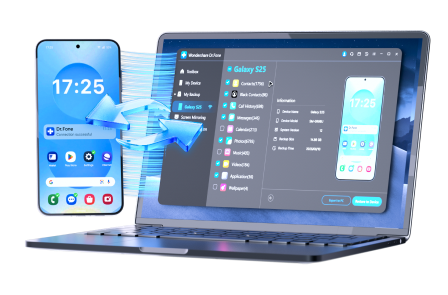
- Transfer all data between devices.
- Robust backup solutions for reliable data protection.
- Mirror screens to PC for meetings, teaching, and control.
-
Step 1 Back up important data first
Use Dr.Fone to back up important photos, messages, and app data (where supported) before you change system settings or update iOS.
-
Step 2 Repair system stability if the iPhone is glitchy
If the iPhone is glitchy after an update, use Dr.Fone’s system repair workflow to address stability issues without improvising risky steps.
-
Step 3 Re-check Always On Display settings
After the phone is stable, return to Settings > Display & Brightness to re-check the Always On Display toggle and related Lock Screen/notification settings.
- If you can still access the phone, start with iOS settings checks and back up your data before major changes.
- If you forgot the passcode, use Apple’s official account recovery and device restore options with proof of ownership.
- If the device is stuck or unstable, prioritize data backup and trusted repair steps before troubleshooting display features.




Part 8. Security, privacy, and compliance notes
Always-On Display is meant to improve convenience while keeping iPhone security intact: the device remains locked, and sensitive content can still be protected by Face ID/passcode and notification preview settings. Because information may be visible at a glance, consider limiting Lock Screen previews for sensitive apps, especially in public or shared spaces. Do not try to bypass device locks, MDM controls, or account protections to change AOD behavior—those safeguards exist to protect owners and organizations. If the iPhone is managed (work/school) or you’re dealing with ownership questions (second-hand devices), the official next step is to contact the organization’s IT/admin or Apple Support and provide valid proof of purchase/ownership.
Conclusion
Always-On Display on iPhone is a Lock Screen feature that keeps key information visible in a dim, low-power view, making quick checks easier while keeping the phone locked. It matters most for convenience, model comparisons, and privacy-aware configuration of Lock Screen content. If broader iOS instability or data-safety concerns get in the way, Dr.Fone may be a practical, legitimate option for backup or system repair before you revisit AOD settings.
FAQ
Q1. Does Always-On Display drain the iPhone battery?
It can increase battery use compared with having the screen fully off, because the display remains active. The actual impact varies by model, settings (widgets/notifications), brightness, and usage patterns, and you can disable AOD any time if battery life is a priority.
Q2. Why can’t I find Always-On Display in Settings?
Most commonly, the iPhone model doesn’t support it or the iOS version/conditions don’t expose the toggle. Check your exact iPhone model, update iOS if appropriate, and look under Settings > Display & Brightness using the Settings search for "Always On."
Q3. Can Always-On Display show notification content when the phone is locked?
It can show notifications, but what’s visible depends on your notification preview settings and whether content is allowed on the Lock Screen. For privacy, adjust Settings > Notifications > Show Previews and per-app notification settings.
Q4. Is Always-On Display the same as Raise to Wake?
No. Raise to Wake turns the screen on when you lift the phone, while Always-On Display keeps a dim Lock Screen visible even when you don’t lift or tap it (on supported models). They’re separate features and can be enabled or disabled independently depending on your device.
 Add Wondershare Dr.Fone as a preferred source on Google