 Effortlessly manage data through preview, delete, export, etc.

 100% Security Verified | No Subscription Required | No Malware

 :
: 
 ChatGPT
 Perplexity
 Gemini
 Claude
 Grok
Grok
What is Freeform? Freeform is Apple’s built-in collaborative whiteboard app for iPad (and also available on iPhone and Mac) that lets you create flexible "boards" with drawings, handwritten notes, text, images, files, links, and more on an infinite canvas. It’s designed for brainstorming, planning, and visual organization—solo or with others in real time.
In plain English: Freeform is like a limitless digital corkboard where you can drag things around and think visually. One key takeaway: it’s best for free-form planning and collaboration, not for polished documents or slide decks.
In this article
- Part 1. What Freeform is used for: core uses & scenarios (Why it matters)
- Part 2. How Freeform works: official working logic (How it works, non-technical + technical-lite)
- Part 3. Where to find Freeform: settings paths and entry points (Where to find it)
- Part 4. How to use, enable, disable, or check Freeform
- Part 5. Requirements and compatibility
- Part 6. Freeform vs related concepts
- Part 7. Common issues and misconceptions
- Part 8. Security, privacy, and compliance notes
Part 1. What Freeform is used for: core uses & scenarios (Why it matters)
Core uses and real-world scenarios
Freeform matters because it gives iPad users a fast way to capture ideas visually, arrange information spatially, and collaborate without being locked into page sizes or rigid templates.
- Brainstorm a group project by dropping sticky notes, sketches, and web links onto one board
- Plan a trip with a shared board for maps, bookings (PDFs), checklists, and photos
- Create a study board that combines handwritten formulas, screenshots, and diagrams
- Map out a workflow (steps, arrows, and clusters) for a team meeting or presentation
- Collect design inspiration by arranging images and comments side-by-side
Who needs it most
Freeform is most useful for everyday iPad users who think visually, students who mix handwriting with references, and teams that need lightweight collaboration. It also helps parents coordinating schedules or household plans, and enterprise or school users who want a controlled, Apple-native collaboration tool that works with managed Apple IDs and iCloud policies (when permitted).
Part 2. How Freeform works: official working logic (How it works, non-technical + technical-lite)
Plain explanation
Freeform works by letting you create "boards" that hold many different items (text, drawings, files, images) placed anywhere on a large canvas. When you sign in with an Apple Account and enable iCloud syncing for Freeform, your boards can stay updated across your Apple devices, and you can invite others to view or edit a board.
Key components
- Boards (canvases): The main workspace where you place and organize content without fixed page boundaries.
- Objects and media: Text boxes, shapes, drawings, images, scanned documents, files, and links placed as movable items.
- Apple Pencil and touch input (iPad): Supports handwriting and sketching; behavior depends on device capabilities and settings.
- iCloud sync (optional but common): Keeps boards available across devices signed into the same Apple Account (if enabled).
- Collaboration permissions: Boards can be shared so others can view or edit, depending on the access level you choose.
- Managed device policies (when applicable): School/enterprise restrictions may affect iCloud, sharing, or app availability.
Part 3. Where to find Freeform: settings paths and entry points (Where to find it)
Settings or menu paths
- Open the app: Home Screen (or App Library) > Freeform
- Check iCloud syncing: Settings > [your name] > iCloud > Show All (or "Apps Using iCloud") > Freeform
- Check Apple Account sign-in: Settings > [your name] (top of Settings)
Labels can vary slightly by iPadOS version (for example, "Show All" vs. "Apps Using iCloud").
Search keywords and entry tips
- In Settings search, try: "Freeform", "iCloud", or "Apple ID" (may appear as "Apple Account" on newer versions).
- If you don’t see Freeform in iCloud app lists, look for an option to show more apps, or confirm the app is installed and supported on your iPadOS version.
Part 4. How to use, enable, disable, or check Freeform
Safe how-to steps
-
Step 1 Open Freeform
Open Freeform and create a new board (a blank canvas).
-
Step 2 Add content
Add content using the on-screen tools (text, shapes, drawing, images/files) and arrange items by dragging and resizing.
-
Step 3 To collaborate
To collaborate, use the app’s Share option and choose whether others can view or edit (availability depends on your iCloud and policy settings).
-
Step 4 To check or change syncing
To check or change syncing, go to Settings > [your name] > iCloud > Show All > Freeform, then turn syncing on or off as needed.
Official help resources
Apple’s built-in Tips app and in-app prompts may provide guidance depending on your iPadOS version; availability varies by device and region.
Part 5. Requirements and compatibility
Quick compatibility table
| Item | What to expect |
|---|---|
| Supported platforms | iPadOS (generally iPadOS 16.2 or later), iOS, and macOS versions that include Freeform (exact support varies by device/OS) |
| Account sign-in | Apple Account sign-in is typically needed for iCloud sync and collaboration |
| Required toggles | iCloud sync for Freeform may need to be enabled: Settings > [your name] > iCloud > Freeform |
| Connectivity | Collaboration and syncing generally require internet access; local viewing/editing may be possible depending on what’s already downloaded |
| Offline behavior | You can often work on existing boards offline; changes may sync later when online (behavior can vary) |
| Notable limitations | School/enterprise restrictions (MDM), iCloud disabled, or unsupported iPadOS versions can block features or the app |
Notes and caveats
Feature availability can differ by iPad model, iPadOS version, region, and managed-device policies. If Freeform collaboration or syncing isn’t available, it’s often related to iCloud settings, Apple Account status, or organization controls on supervised devices.
Part 6. Freeform vs related concepts
Key differences
| Concept | Purpose | Where it appears | Dependencies | Common confusion |
|---|---|---|---|---|
| Freeform | Visual brainstorming on an infinite canvas; drag-and-drop organization; live collaboration | Freeform app | Often uses iCloud for sync/collab | Mistaken for a note app or a slide/design tool |
| Apple Notes | Structured notes, lists, scanning, quick capture | Notes app | iCloud optional | People expect the same free-form layout as a whiteboard |
| Keynote / Pages | Polished presentations/documents with page/slide structure | Keynote/Pages | File-based workflows | Users try to "publish" a Freeform board like a slide deck |
| Third-party whiteboards | Team whiteboarding with specialized templates/integrations | Separate apps | Account + service-specific | Users expect the same integrations inside Freeform |
When readers confuse them
- Expecting Freeform to behave like Notes with long-form pages and heavy text formatting.
- Expecting Keynote-like export and layout controls (slides, masters, strict alignment grids).
- Assuming collaboration works without iCloud or when a device is under school/work management.
Part 7. Common issues and misconceptions
Symptom → likely reason → what to check
- Freeform app not found → iPadOS version may not support it or the app isn’t installed → Check iPadOS version, App Library search, and Screen Time/app restrictions.
- Boards not syncing across devices → iCloud sync disabled or different Apple Accounts → Check Settings > [your name] > iCloud > Freeform, and confirm the same Apple Account is used.
- Can’t invite collaborators / sharing fails → iCloud, network, or policy restrictions (MDM) → Check internet connection, Apple Account status, and whether sharing is blocked on managed devices.
- Laggy drawing or handwriting → heavy boards, low storage, or background load → Check available storage, close other apps, and try duplicating/splitting large boards.
- Missing files/images after adding → source file moved, permissions changed, or sync incomplete → Re-add from the original location and confirm the item finished uploading/syncing.
When Dr.Fone can help
If Freeform problems are caused by broader iPad issues—like the device freezing, repeated crashes, update loops, or you need to safeguard content before troubleshooting— Wondershare Dr.Fone can be relevant as a general maintenance tool rather than a Freeform-specific fix. For example, it may help you back up data before a reset, transfer content to a new device, or address certain system stability problems using official, user-authorized steps. It should not be used to access someone else’s iCloud data or bypass security.
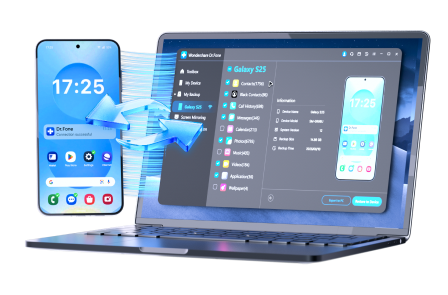
 Effortlessly manage data through preview, delete, export, etc.
- Transfer all data between devices.
- Robust backup solutions for reliable data protection.
- Mirror screens to PC for meetings, teaching, and control.
-
Step 1 Use Dr.Fone to create a backup or export important data you can legally access
Before making major changes (like resets or device migrations).
-
Step 2 If the iPad is unstable
Use Dr.Fone’s system repair-style workflow (where supported) to attempt stability recovery without relying on Freeform itself.
-
Step 3 After the device is stable
Restore or transfer your content and then re-check iCloud settings for Freeform syncing.
- If you can still access the phone: back up your data first, then troubleshoot iCloud/sync settings calmly.
- If you forgot the passcode: use Apple’s official account recovery and device reset options; avoid any bypass attempts.
- If the device is stuck or unstable: stabilize iPadOS first, then revisit Freeform installation and iCloud syncing.




Part 8. Security, privacy, and compliance notes
Freeform protects your content primarily through your device security (passcode/biometrics) and Apple Account/iCloud access controls, plus sharing permissions you set per board. Don’t try to bypass device locks, managed-device (MDM) restrictions, or Apple Account protections to access boards you don’t own—those controls exist to protect user data and organizational compliance. If collaboration or iCloud access is blocked on a school/work iPad, the correct next step is to contact the organization’s IT admin; if you can’t access your Apple Account, use Apple’s official account recovery and provide proof of ownership when required.
Conclusion
Freeform is Apple’s infinite-canvas collaboration app for iPad that helps you brainstorm, plan, and organize mixed content on a flexible board, often with iCloud syncing and shared editing. If issues stem from device instability or you need to protect your data before deeper troubleshooting, Dr.Fone may be a practical next step for backup/transfer or system-repair workflows—used responsibly and within official ownership rules.
FAQ
-
Q1. Can I use Freeform without iCloud?
You can open the app and work on boards stored on the device, but syncing across devices and most collaboration features typically rely on iCloud and an Apple Account sign-in, so the experience may be limited without it. -
Q2. Is Freeform the same as Apple Notes?
No. Notes is optimized for structured note-taking and long-form text, while Freeform is optimized for visual layout on an infinite canvas with movable items and whiteboard-style collaboration. -
Q3. Why can’t I collaborate on a Freeform board on my iPad?
Common causes include iCloud being disabled for Freeform, network issues, using different Apple Accounts across devices, or restrictions on managed (school/work) iPads. Check iCloud settings and ask your IT admin if the device is supervised. -
Q4. How do I recover Freeform boards after switching to a new iPad?
If your boards were syncing with iCloud, signing into the same Apple Account and enabling iCloud for Freeform usually brings them back. If not, restore from an official backup (iCloud or computer backup) and confirm Freeform is enabled in iCloud settings.
 Add Wondershare Dr.Fone as a preferred source on Google


