Effortlessly manage data through preview, delete, export, etc.

 100% Security Verified | No Subscription Required | No Malware

 :
: 
 ChatGPT
 Perplexity
 Gemini
 Claude
 Grok
Grok

“Best” answers rarely help when you’re choosing stop intervals for simulated gameplay routes, because what feels “natural” depends on your route type, goals, and what you’re trying to avoid (boring pacing, unrealistic movement, broken quests, etc.).
Forum user
AI helps by turning fuzzy preferences like “more realistic” or “less grindy” into explicit trade-offs: where stops should happen, how long they should last, and what signals should trigger them.
AI can’t verify hands-on feel, moment-to-moment flow, or real player friction—so after you narrow the decision, you still need small tests (even quick paper prototypes) to confirm the intervals actually play well.

In this article
- How to compare stop-interval approaches based on real priorities
- Choose a pacing model (fixed vs context-aware)
- Define what “natural” means in your context
- Balance player feel vs reproducible routes
- Identify trade-offs before testing
- What the AI needs to compare
- Using AI prompts to evaluate stop intervals more clearly
- AI recommendation vs real-world fit
- When to stop researching and make the call
Part 1. How to Compare Stop-Interval Approaches Based on Real Priorities
When you design stop intervals, you’re really choosing a pacing model: do stops happen on a fixed cadence, or should they respond to context (terrain, objectives, points of interest, player fatigue loops, narrative beats)?
The tension is that “natural” can mean different things: believable human rhythm, fun gameplay rhythm, or stable simulation behavior for QA/testing. A model that feels authentic can still feel slow or tedious; a model that feels efficient can still feel robotic.
Another common uncertainty: you may be trying to satisfy two audiences at once—players who want smooth progression and designers/testers who need reproducible routes—yet those needs push interval design in opposite directions.
Part 2. What the AI Needs to Compare
Answer these so the AI can compare options in a way that matches your real constraints:
- The purpose of the simulated route (player guidance, NPC travel, QA automation, accessibility practice, etc.)
- Your route archetype (linear path, hub-and-spoke, loop, multi-stop itinerary, branching quests)
- What “natural” means in your context (believable, varied, efficient, narrative-aligned, low-cognitive-load)
- The stop trigger candidates you’re considering (time-based, distance-based, event-based, POI-based, stamina/fatigue-based)
- How much variability you want (deterministic vs lightly randomized vs highly dynamic)
- The cost of being “wrong” (players bored, objectives misfire, analytics skew, test flakiness)
- Any hard constraints (session length, quest timers, battery/performance budgets, accessibility pacing)
Part 3. Using AI Prompts to Evaluate Stop Intervals More Clearly
Use the prompts below to force a trade-off-driven comparison instead of a vague “make it realistic” discussion.
3-1. Level 1: Basic Prompt
Compare these two stop-interval approaches for my simulated gameplay routes: (A) fixed stops every X minutes/meters, and (B) context-aware stops triggered by points of interest and objectives.
Explain the main trade-offs and when each approach will feel more natural.
3-2. Level 2: Advanced Prompt
I’m choosing a stop-interval model for simulated gameplay routes. Compare these options using my priorities and tell me who each fits best:
- Option 1: time-based intervals (fixed cadence)
- Option 2: distance-based intervals (fixed spacing)
- Option 3: event/POI-based intervals (context triggers)
- Option 4: hybrid (baseline cadence + context overrides)
My priorities are: [fun pacing vs realism vs repeatability], [low complexity vs high control], and [consistent analytics/test results vs varied player feel].
For each option, list: what it optimizes for, what it risks, and the type of route where it’s a strong fit.
3-3. Level 3: Evidence Prompt
Here’s my real context:
- Route type: [loop / linear / hub-and-spoke / branching]
- Session length target: [e.g., 20–30 min]
- Route content: [e.g., 6 objectives, 10 POIs, 2 “rest” beats, 1 timed quest]
- Biggest current problem: [e.g., feels robotic / players stall / QA runs aren’t reproducible]
- Constraints: [e.g., must be deterministic for testing OR must feel varied for players]
Recommend one stop-interval approach (time-based, distance-based, POI/event-based, or hybrid).
Explain what I gain and what I give up with your recommendation versus the runner-up.
Finally, name one key assumption you’re making that—if false—would flip your recommendation, and tell me what to choose instead.
3-4. Prompt Refinement
If I had to pick only one definition of “natural” here—believability, fun pacing, or repeatability—which should I prioritize given my context, and what would I regret about the other two?
List the top 5 failure modes for each interval model (fixed, context-based, hybrid) in my route type, and how I would notice them during playtests.
Propose a minimal A/B test I can run in one afternoon to compare two interval models, including what to log (drop-off points, idle time, objective completion time, backtracking).
Where should variability be allowed and where should it be banned (e.g., stop duration variance vs stop placement variance), if I want “natural” without breaking consistency?
If my main risk is players feeling stalled, how should intervals change (shorter stops, fewer stops, different triggers), and what new risk does that create?
Part 4. AI Recommendation vs Real-World Fit
| Likely AI recommendation or conclusion | What real-life use may change or reveal |
|---|---|
| “Use a hybrid model: baseline cadence plus POI/objective overrides.” | The hybrid may feel “over-designed” and inconsistent if POIs cluster or objectives stack. |
| “Prefer deterministic intervals for QA/testing routes.” | Determinism can expose repetitive boredom that undermines long session engagement. |
| “Add light randomness to avoid robotic timing.” | Randomness can create edge cases: awkward stops mid-action, broken narrative beats, or timing clashes. |
| “Anchor stops to meaningful moments (objectives/POIs).” | Some “meaningful” moments aren’t restful; players may perceive forced interruptions as friction. |
AI can clarify likely fit and trade-offs, but hands-on use, workflow friction, and daily habits still decide satisfaction—especially once real routes produce clustered events, unexpected detours, and player-driven pacing.
Part 5. When to Stop Researching Stop Intervals and Make the Call
- You can state your primary objective in one line (e.g., “fun pacing over strict realism” or “repeatable QA runs over variety”).
- You’ve chosen one primary trigger (time/distance/event) and decided whether a hybrid override is allowed.
- You know your biggest acceptable downside (what you’re willing to give up) and why it’s acceptable.
- You have a small validation plan (one route, two variants, clear success signals) instead of more debate.
At this point, you’re no longer missing information—you’re ready to pick a model and validate it quickly.
After Choosing Stop Intervals: Switch or Prepare Smoothly with Dr.Fone
Once your interval model is decided, the practical work is often about validating it consistently across devices and sessions. If your testing involves location-based routes, Dr.Fone - Virtual Location can help you simulate movement and stops in a controlled way while you iterate on pacing.
 Set your map route to simulate GPS movement.
- Set your wanted movement speed.
- HD and large map view to check location.
- Fake GPS location to anywhere.

-
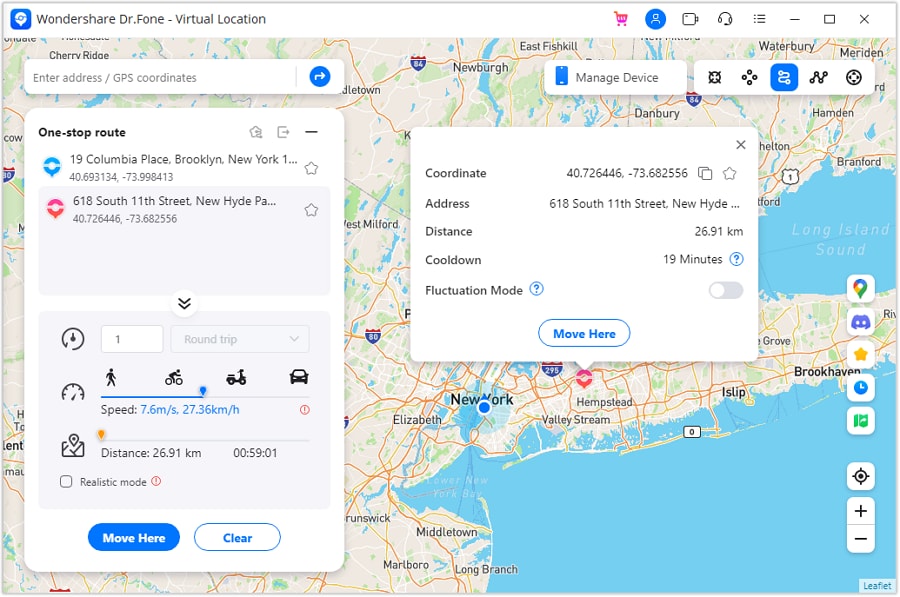
Step 1 Activate One-Stop Route mode
Choose a single destination route mode so you can prototype one set of stop intervals without branching complexity.
-
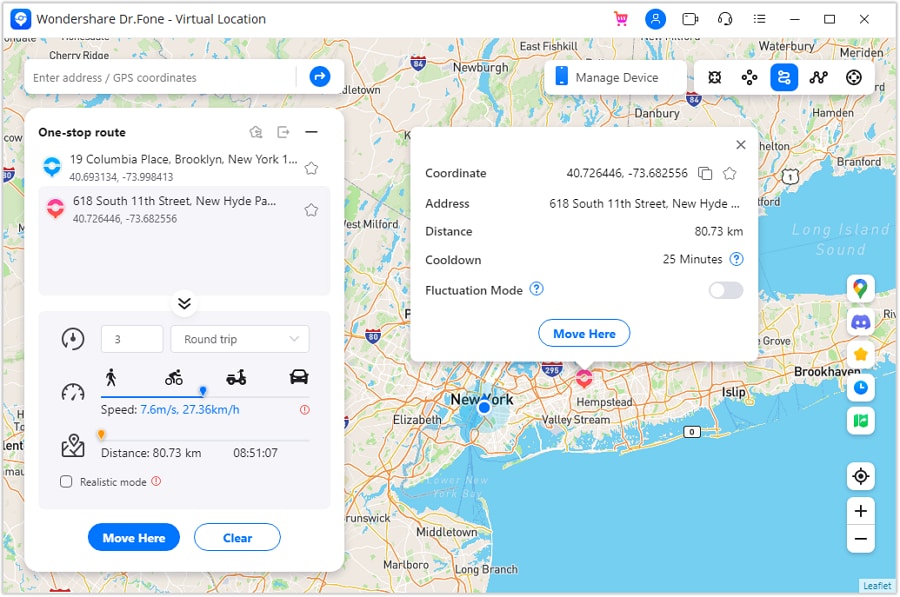
Step 2 Set simulation parameters (pace, spacing, and timing)
Adjust movement and timing parameters to match the interval model you’re validating (fixed cadence, distance spacing, or a hybrid you want to emulate).
-
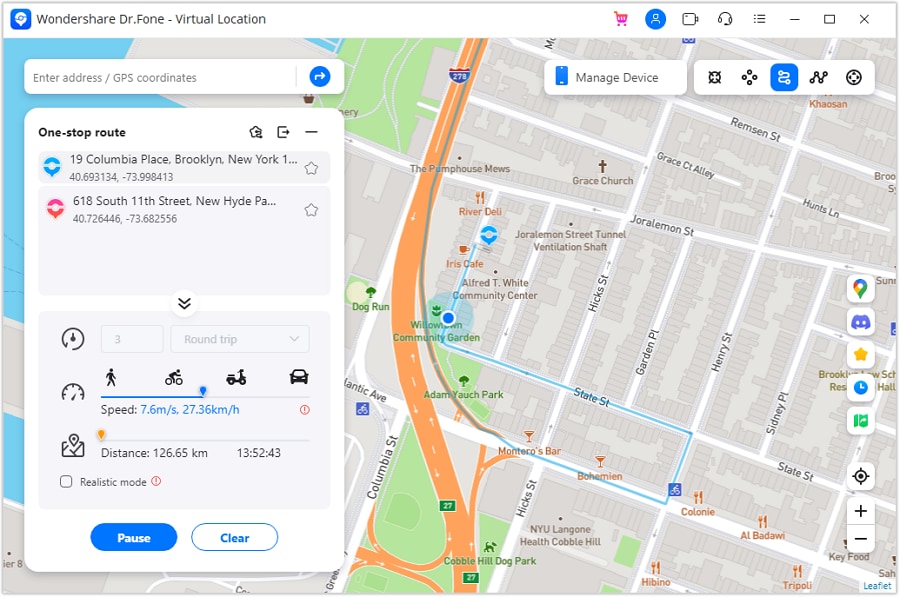
Step 3 Start One-Stop simulation and capture results
Run the route and record your chosen signals (idle time, objective completion time, drop-off points, backtracking) so you can compare interval models fairly.
-
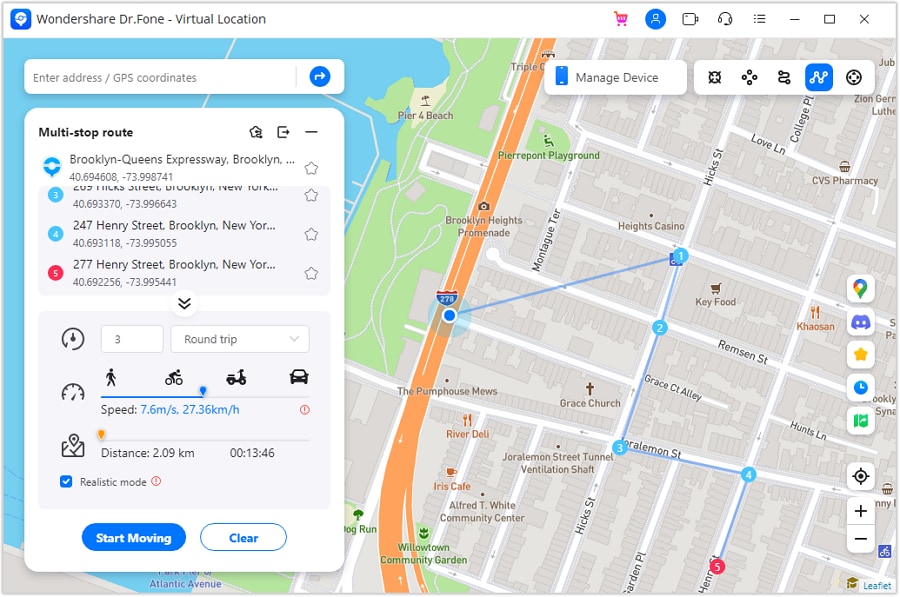
Step 4 Switch to Multi-Stop simulation for itinerary-style routes
For multi-stop or POI-heavy routes, use a multi-stop setup to see how clustering and stacked objectives affect perceived “naturalness.”
Separately from route simulation, device workflow still matters when you iterate quickly: keep test assets organized, back up before aggressive changes, and clean up personal data when devices are reassigned or prepared for resale.




Conclusion
AI is best used here as decision support—forcing clear trade-offs, fit, and regret points—while real use is the final proof; once you’ve chosen an interval model, tools like Dr.Fone help with the practical execution (transfer, backup, cleanup) if you’re switching devices or preparing one for handoff.
FAQ
-
Can I trust AI to tell me what stop intervals feel natural?
Trust it to structure trade-offs and highlight failure modes. Don’t trust it to “feel” pacing—validate with a small playtest or scripted run. -
What’s the single most important trade-off in stop-interval design?
Repeatability vs responsiveness: fixed models are easier to predict and test; context-aware models can feel more organic but can behave unpredictably when content clusters. -
How do I avoid a generic, spec-like decision (e.g., “just do every 2 minutes”)?
Tie intervals to a priority (fun, realism, repeatability) and a route archetype. Then choose triggers and variability rules that serve that priority. -
What should I prepare before I run comparisons?
One representative route, two interval variants, and 3–5 measurable signals (completion time, idle time, backtracking, drop-off points, perceived interruption). -
If I’m switching devices for testing or handing a device off, what matters most?
Make sure your test assets are transferred, your baseline is backed up, and personal data is removed before resale or reassignment.
 Add Wondershare Dr.Fone as a preferred source on Google