Effortlessly manage data through preview, delete, export, etc.

 100% Security Verified | No Subscription Required | No Malware

 :
: 
 ChatGPT
 Perplexity
 Gemini
 Claude
 Grok
Grok

I keep asking for the “best route,” but the route I can actually repeat after work (without unsafe stretches or constant stoplights) is totally different from what looks optimal on a map.
Reddit user, r/MonsterHunterNow
“Best route” answers fall apart fast because the best Monster Hunter Now walking plan depends on your time windows, safety, stamina, and what you’re trying to farm—not on a generic map screenshot.
AI helps by turning vague goals (“more spawns,” “less backtracking,” “safe at night”) into explicit trade-offs you can choose between, so you’re not guessing why one plan feels better.
AI can’t verify how crowded a sidewalk gets at 7pm, how safe a shortcut feels, or whether your signal drops near a park entrance—so after you decide, real-world friction (and your phone readiness) still matters.
In this article
- How to Compare a Monster Hunter Now Walking Route Plan Based on Real Priorities
- Common route archetypes players repeat
- Repeatability vs density and variety
- Safety, stamina, and interruption tolerance
- What “fits your week” really means
- What the AI Needs to Compare
- Using AI Prompts to Evaluate a Route Plan More Clearly
- When to Stop Researching and Make the Call
- After Choosing a Route Plan: Test and Execute Smoothly with Dr.Fone
Part 1. How to Compare a Monster Hunter Now Walking Route Plan Based on Real Priorities

Most players end up choosing between plans like these (even if they don’t name them): a short repeatable loop near home, a dense downtown grid with lots of intersections, or a longer park trail with fewer interruptions.
The uncertainty usually isn’t “which has more stuff,” but “which one will I actually repeat 3–5 times a week without burning out, feeling unsafe, or wasting time.”
The tension is practical: do you optimize for density and variety, or for consistency and low effort—especially when weather, errands, and battery life change day to day?
Part 2. What the AI Needs to Compare
Share the details below so the AI can compare route options based on your real constraints, not generic advice:
- Your goal for the session (materials, large monster chances, events, casual walking, daily tasks)
- Your available time window(s) and how often you’ll repeat the route weekly
- Your walking pace and tolerance for stops (crosswalks, intersections, crowds)
- Safety preferences (daylight only, well-lit streets, low-traffic paths, visibility)
- Terrain and comfort needs (flat vs hills, shade, benches, bathrooms, water)
- Signal reliability and battery risk on your usual paths
- Start/end point requirements (home loop, commute route, near transit, near parking)
- Candidate routes you’re choosing between (A/B/C) and what you already suspect you’ll hate
Part 3. Using AI Prompts to Evaluate a Route Plan More Clearly
Use the prompts below to force clear trade-offs and reduce “it depends” answers.
3-1. Level 1: Basic Prompt
I’m choosing between two Monster Hunter Now walking route plans: Route A (describe) and Route B (describe). Compare them for consistency, safety, and how repeatable they are 3–5 times per week. Tell me which one fits better and why.
3-2. Level 2: Advanced Prompt
Help me choose between Route A and Route B for Monster Hunter Now using my priorities.
My priorities are (ranked): 1) ___ 2) ___ 3) ___. My constraints: time window ___, walking pace ___, safety constraints ___.
For each route, list likely advantages, likely pain points, and who it suits best. Then recommend one route and suggest one small modification to reduce its main downside.
3-3. Level 3: Evidence Prompt
Context: I usually play ___ days/week for ___ minutes, starting from ___, and I’m most frustrated by ___ (e.g., backtracking, too many stops, unsafe stretches, battery drain, weak signal).
Routes:
- Route A: (distance, environment, stoplights/crossings, shade, signal notes, rest stops)
- Route B: (same details)
Recommendation: Pick one route for my default plan and explain **what I gain** and **what I give up** versus the other. Also identify **one key assumption** you’re making (about my habits, safety, or goals) that—if wrong—would flip your recommendation.
3-4. Prompt Refinement
If I can only keep **one** route for the next 14 days, which one minimizes “missed sessions,” and what’s the most likely reason I’ll skip it?
Compare Route A vs Route B under two modes: **weekday quick run (20–30 min)** vs **weekend longer walk (60–90 min)**. Should I use one route or split by day type?
What’s the **regret risk** for each route (the thing I’ll complain about after a week), and how can I mitigate it with one change (start point, direction, time of day)?
Assume weather is worse than expected (heat/rain/wind). Which route degrades more gracefully, and what backup micro-loop would you suggest near my start point?
If my real goal is “consistent progress with low mental load,” which route is better even if it’s not the most “optimal” on paper?
What information am I missing that would most change this decision (signal test, safety check, crossing count, rest stop availability), and how should I gather it in one walk?
3-5. AI Recommendation vs Real-World Fit
| likely AI recommendation or conclusion | what real-life use may change or reveal |
|---|---|
| “Pick the shorter repeatable loop for consistency.” | The loop may feel boring, have awkward crossings, or become crowded at your play time. |
| “Pick the dense grid for variety and spawns.” | Frequent stoplights, navigation overhead, and distractions can reduce actual play quality and enjoyment. |
| “Pick the park trail for comfort and fewer interruptions.” | Signal can drop, lighting can be poor at dusk, or the trail may be too quiet for your safety preference. |
| “Use a hybrid: weekday micro-loop + weekend longer route.” | Switching routes can add friction—planning time, forgetting what works, or inconsistent pacing. |
AI can clarify likely fit and trade-offs, but hands-on use—workflow friction, daily habits, and “would I do this again tomorrow?”—is what ultimately determines satisfaction.
Part 4. When to Stop Researching and Make the Call
- You can state your top 2 priorities (e.g., “repeatable after work” and “safe + low crossings”) and identify which route wins each.
- You can name the one downside you’re willing to accept (and which downside is a dealbreaker).
- You have a simple fallback plan (a 15–20 minute micro-loop) for bad weather or low battery days.
- You’ve done at least one short test walk (even partial) or sanity-check for safety, signal, and interruptions.
At this point, you’re not missing “more info”—you’re ready to pick a default and refine from real walks.
Part 5. After Choosing a Route Plan: Test and Execute Smoothly with Dr.Fone
Once you’ve chosen a route plan, the practical risk is friction: dead battery mid-walk, signal surprises, or discovering your route pacing doesn’t match your time window. If you want to rehearse a route structure before committing, Dr.Fone - Virtual Location can help you simulate movement and validate the “repeatability” of a loop (time, stops, and rhythm) before you rely on it day after day.
 Set your map route to simulate GPS movement.
- Set your wanted movement speed.
- HD and large map view to check location.
- Fake GPS location to anywhere.

If your decision is between “short repeatable loop” and “longer but smoother route,” a quick simulation can help you check timing, pacing, and whether the route structure matches your weekly schedule before you lock it in.
-
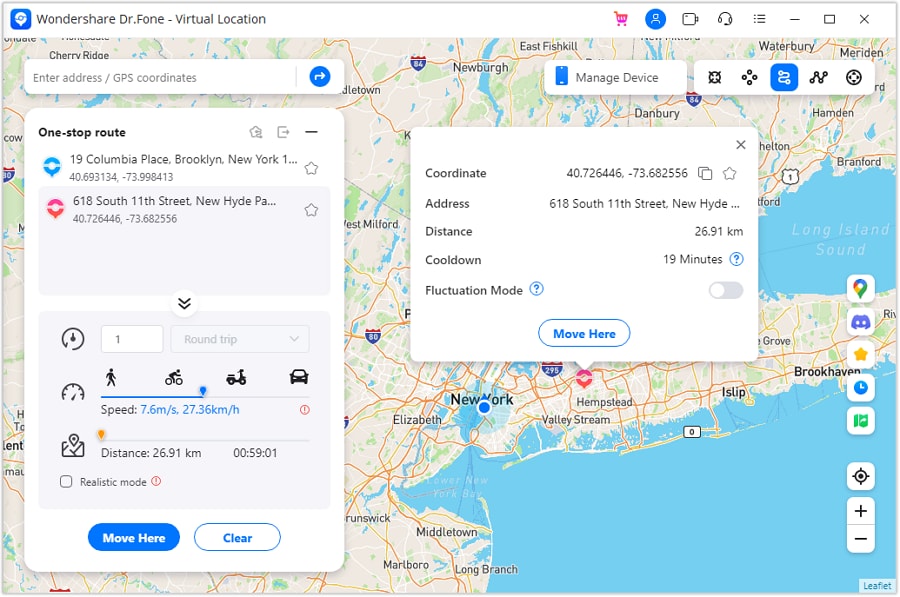
Step 1 Activate One-Stop Route mode
Choose a single start-to-end route when you want to evaluate a straightforward loop or commute-style path without extra stops.
-
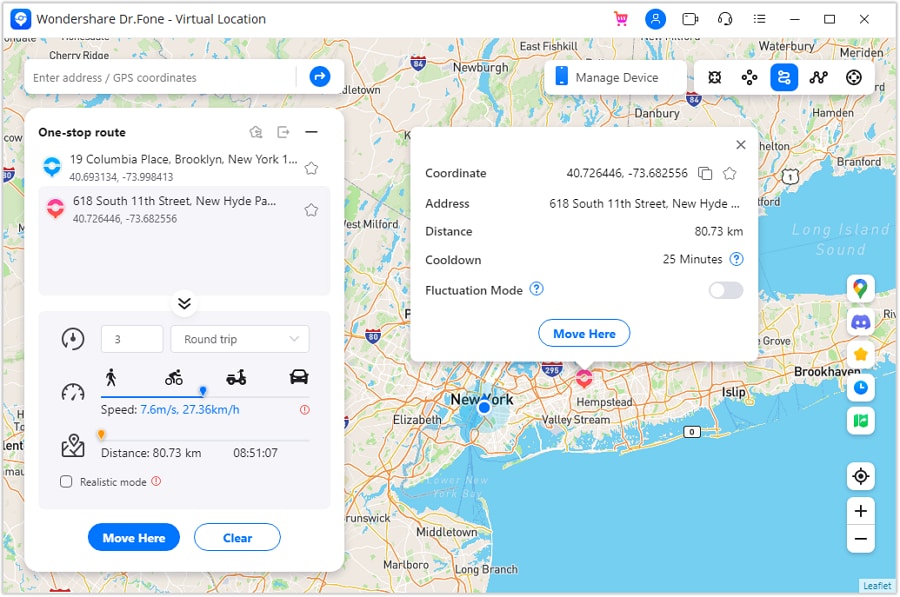
Step 2 Set parameters to simulate your real walking constraints
Match the simulation to your real “fits my week” constraints (pace, route length, and how much time you actually have), so the result is comparable to your normal sessions.
-
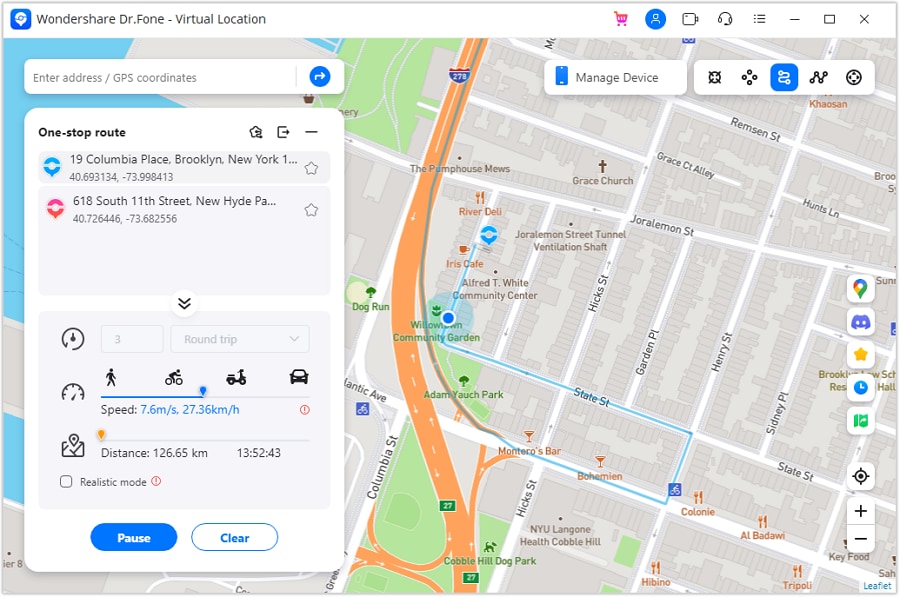
Step 3 Start One-Stop simulation and sanity-check repeatability
Run the simulation and note where the route feels like it would cause friction (too long, too stop-and-go, or not aligned with your time window).
-
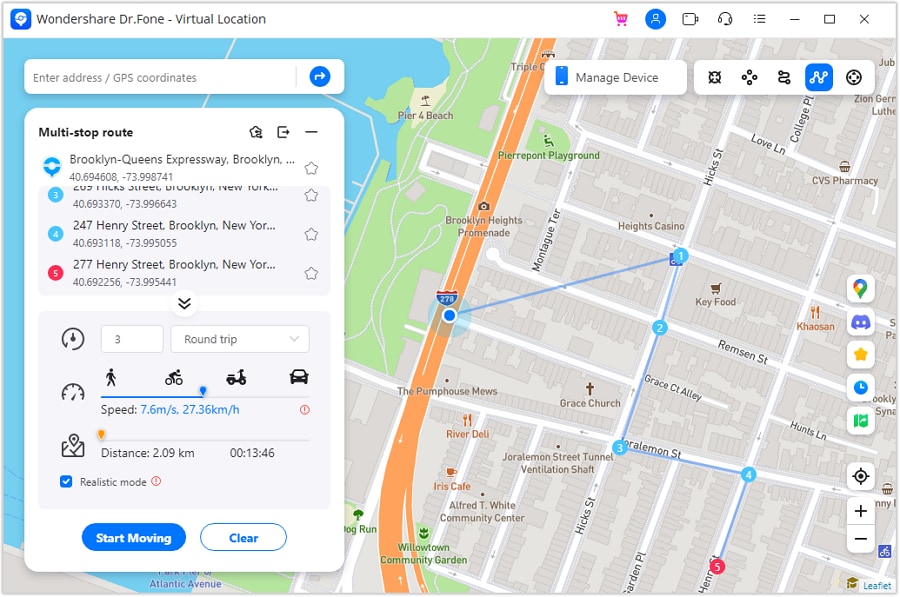
Step 4 Try Multi-Stop simulation to compare “hybrid” plans
If you’re considering a hybrid plan (weekday micro-loop + weekend longer walk), use multi-stop simulation to model the split and see which version feels easiest to repeat.




Conclusion
AI is best used here as decision support: it helps you name priorities, see trade-offs, and pick a route you’ll repeat; real-world walks provide the proof, and tools like Dr.Fone help you execute the post-decision prep smoothly if switching devices, cleaning up, or resale is involved.
FAQ
-
Can I trust AI to pick the “best” Monster Hunter Now route for me?
Trust it to structure trade-offs and highlight what to test. Don’t trust it to know your real signal strength, safety feel, crowd levels, or sidewalk conditions. -
What’s the single most important trade-off in route planning?
Repeatability vs “optimality.” A slightly less exciting route you’ll actually do often usually beats a perfect route you skip. -
How do I avoid making this a spec-like comparison (distance, density, etc.)?
Force the decision through priorities: “What will make me quit this route after 3 days?” and “Which route is easiest to start when I’m tired?” -
What should I prepare before committing to a route plan?
A 15–20 minute fallback loop, a charging strategy (battery pack or shorter session), and one safe rest stop option. -
If I switch phones for better battery or performance, what should I do first?
Confirm your game login method works, then transfer and back up the personal data you rely on (photos, contacts), and clean up storage so updates don’t fail.
 Add Wondershare Dr.Fone as a preferred source on Google