Effortlessly manage data through preview, delete, export, etc.

 100% Security Verified | No Subscription Required | No Malware

 :
: 
 ChatGPT
 Perplexity
 Gemini
 Claude
 Grok
Grok
What is Spatial Video? Spatial Video is Apple’s 3D-style video format that records a scene with depth, creating a more lifelike playback experience on compatible devices (notably Apple Vision Pro). On supported iPhones, it uses multiple cameras and software processing to capture slightly different perspectives and package them into a single video file.
In plain English: Spatial Video is a "more real" video that can look like you’re back in the moment when viewed on the right hardware. One key takeaway: you can record Spatial Video on certain iPhone models, but the best experience is viewing it on Apple Vision Pro (or other compatible Apple playback options as they evolve).
In this article
- Part 1. What Spatial Video is used for: core uses & scenarios (Why it matters)
- Part 2. How Spatial Video works: official working logic (How it works, non-technical + technical-lite)
- Part 3. Where to find Spatial Video: settings paths and entry points (Where to find it)
- Part 4. How to use, enable, disable, or check Spatial Video
- Part 5. Requirements and compatibility
- Part 6. Spatial Video vs related concepts
- Part 7. Common issues and misconceptions
- Part 8. Security, privacy, and compliance notes
Part 1. What Spatial Video is used for: core uses & scenarios (Why it matters)
Core uses and real-world scenarios
Spatial Video matters because it preserves depth and perspective, which can make memories and demonstrations feel closer to real life than standard 2D clips—especially when played back in a headset that supports spatial viewing.
- Recording family milestones (birthdays, graduations) to re-experience with a stronger sense of presence later
- Capturing travel moments (street scenes, landmarks) where depth adds realism
- Filming a home walkthrough for renovation planning or furniture layout review
- Creating product demos (size/spacing context) for clients or collaborators
- Documenting performances or sports moments where distance and positioning matter
Who needs it most
Spatial Video is most useful for everyday users who want richer personal memories, creators experimenting with new formats, and professionals who benefit from spatial context (real estate, design, on-site documentation). It can also matter to second-hand buyers/sellers who want to confirm a device supports the feature before purchase, and to parents who should consider privacy implications when recording in sensitive environments.
Part 2. How Spatial Video works: official working logic (How it works, non-technical + technical-lite)
Plain explanation
When you record Spatial Video, the iPhone captures the scene using more than one camera angle at the same time. Your iPhone then aligns those views, estimates depth, and saves the result as a video that can be played back with a sense of dimension on compatible devices.
Key components
- Supported camera hardware (typically specific multi-camera "Pro" systems; exact support varies by model)
- iOS-level processing that synchronizes camera streams and computes depth cues
- A Spatial Video recording mode or toggle (so the phone knows to capture/encode in the spatial format)
- Storage and encoding requirements (files can be larger than typical 2D video, depending on settings)
- Playback compatibility (the "3D effect" depends on a device/player that supports spatial playback)
Part 3. Where to find Spatial Video: settings paths and entry points (Where to find it)
Settings or menu paths
- iPhone: Settings > Camera > Formats > Spatial Video (wording may appear as "Spatial Video for Apple Vision Pro" depending on iOS version)
- Camera app entry point (supported models): Open Camera > switch to Video > look for a Spatial option/indicator (labeling can vary by iOS version)
Search keywords and entry tips
- Settings search keywords: "Spatial Video", "Formats", "Vision Pro"
- Tip: If you don’t see "Spatial Video," confirm you’re on a supported iPhone model and that iOS is updated; Apple sometimes adjusts the label or placement across iOS releases.
Part 4. How to use, enable, disable, or check Spatial Video
Safe how-to steps
-
Step 1 Find the Spatial Video setting in Camera Formats
Go to Settings > Camera > Formats and look for a Spatial Video option; turn it on (or off) if available.
-
Step 2 Confirm the Spatial option in the Camera app
Open the Camera app, switch to Video, and confirm Spatial recording is selected/indicated (if your device supports it).
-
Step 3 Record with steady framing and good lighting
Record your clip normally, keeping the phone steady and the subject well-lit for better depth results.
-
Step 4 Verify the clip saved in Photos
Open the Photos app to confirm the video saved and check for any Spatial/3D indicator on the clip (labels vary).
-
Step 5 View the clip on compatible playback hardware
If you use Apple Vision Pro, play the clip from your library there to view it in spatial form (availability varies by ecosystem/app updates).
Official help resources
Apple’s in-device tips (Settings search and Camera/Photos help prompts) are the safest place to confirm the exact wording and placement for your iOS version, since labels can change over time.
Part 5. Requirements and compatibility
Quick compatibility table
| Item | What to expect |
|---|---|
| Supported devices/platforms | Recording typically requires certain iPhone "Pro" models with multi-camera systems (for example, iPhone 15 Pro/Pro Max and later Pro models); viewing the full spatial effect is best on Apple Vision Pro; exact support varies by device and OS version |
| Account sign-in | Usually not required just to record; Apple ID may be required for certain sync features (iCloud Photos) |
| Required toggles | Settings > Camera > Formats > Spatial Video (label may mention Apple Vision Pro) |
| Connectivity | Not required to record; internet may be needed for syncing/sharing or software updates |
| Offline behavior | Recording and local playback work offline; spatial playback capability depends on the device/player |
| Notable limitations | Larger file sizes; needs compatible hardware/software; sharing to non-Apple platforms may reduce it to standard 2D playback or lose spatial context |
Notes and caveats
Spatial Video availability can differ by iPhone model, iOS version, region, and Apple’s ongoing software changes. Even when you can record it, how it appears in Photos and how it plays back can vary depending on where you view or share the file.
Part 6. Spatial Video vs related concepts
Key differences
| Concept | Purpose | Where it appears | Dependencies | Common confusion point |
|---|---|---|---|---|
| Spatial Video | Personal 3D-style memories with depth | iPhone Camera/Photos (supported models), best on Vision Pro | Supported iPhone hardware + iOS feature + compatible playback | People assume it’s "VR video," but it’s not the same as 360° |
| Standard (2D) video | Universal video capture and sharing | Any phone camera and any video player | Minimal; widely compatible | Viewed everywhere, but no depth effect |
| 360°/VR video | Look around in all directions | Specialized camera/workflows; some apps support | 360 capture + compatible player | "3D" and "360" are different experiences |
| Apple Immersive Video (professionally produced) | High-end immersive experiences | Typically curated/pro services, not standard iPhone capture | Professional capture pipeline | Users may expect iPhone Spatial Video to match cinematic immersive content |
When readers confuse them
- Spatial Video is not the same as 360° video; it adds depth, not full "look anywhere" viewing.
- A Spatial Video file may play as normal 2D video on many screens, which can make it seem "not working."
- "3D video" is a broad term; Spatial Video is Apple’s specific approach with Apple-focused playback.
Part 7. Common issues and misconceptions
Symptom → likely reason → what to check
- "I can’t find Spatial Video in Settings." → Device/iOS not supported or outdated → Check your exact iPhone model and update iOS; then re-check Settings > Camera > Formats.
- "My Spatial Video looks like a normal video on my iPhone." → Full spatial effect depends on compatible playback → Check playback on a supported device/player (for example, Vision Pro) and confirm the clip is recognized as spatial in Photos.
- "The Spatial option is missing in the Camera app." → Feature toggle off or camera mode not set correctly → Turn on Spatial Video in Settings and switch to Video mode; look for a Spatial label/indicator.
- "Files are taking up a lot of storage." → Spatial capture can increase file size → Check iPhone storage, consider offloading via Photos sync, external transfer, or trimming clips.
- "Shared clips don’t look spatial for others." → Recipient/platform may not support spatial metadata/playback → Share within compatible Apple workflows when possible, and set expectations for 2D playback elsewhere.
When Dr.Fone can help
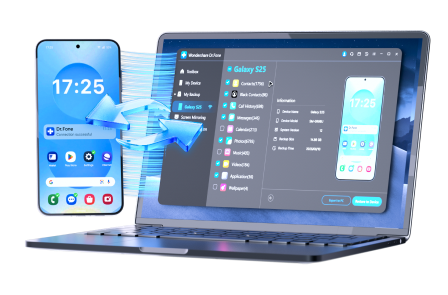
If your Spatial Videos are important memories, the main risk is accidental deletion, failed transfers, or device instability that prevents access to your Photos library. Wondershare Dr.Fone can be relevant in legitimate scenarios like backing up media, transferring videos to a computer/another phone, recovering deleted photos/videos (where recovery is possible), or repairing a system issue that keeps the device from working normally. It is not a tool to bypass Apple security or access someone else’s files.
 Effortlessly manage data through preview, delete, export, etc.
- Transfer all data between devices.
- Robust backup solutions for reliable data protection.
- Mirror screens to PC for meetings, teaching, and control.
-
Step 1 Back up iPhone media before major changes
Use Dr.Fone to back up your iPhone media (including videos) to a computer before major iOS changes or device migration.
-
Step 2 Scan for missing Spatial Video files (where supported)
If a Spatial Video is missing, use Dr.Fone’s data recovery workflow (where supported) to scan for recently deleted/lost media and restore it to a safe location.
-
Step 3 Repair system instability to access Photos again
If the iPhone is unstable (crashes, boot issues), use Dr.Fone’s system repair options to attempt a standard recovery so you can access Photos again.
- If you can still access the phone, prioritize a full backup/export of your Photos library first.
- If you forgot the passcode, use Apple’s official account recovery and device restore paths rather than trying to circumvent security.
- If the device is stuck or unstable, focus on system stabilization/repair so you can retrieve your own files safely.




Part 8. Security, privacy, and compliance notes
Spatial Video can capture more contextual detail (including people and surroundings) than you may realize, so it’s important to get consent when recording others and to avoid filming sensitive information in homes, workplaces, schools, or medical settings. Don’t try to bypass device locks, Apple ID protections, or organizational controls (such as MDM) to access Spatial Videos—those safeguards exist to protect owners and comply with policy. If ownership is unclear (second-hand devices) or the iPhone is managed by an employer/school, the correct next step is to verify ownership (proof of purchase/original owner assistance) and use official Apple or organization support channels.
Conclusion
Spatial Video is Apple’s depth-enabled video format that lets certain iPhones record more lifelike memories for the best playback on Apple Vision Pro, and it matters because it preserves perspective in a way standard video cannot. You can usually find it under Camera settings and use it like a normal video mode once enabled. If you run into lost files, transfer trouble, or device instability, Dr.Fone may be a reasonable, safety-minded option for backup, recovery, or repair—without bypassing Apple’s protections.
FAQ
Q1. Can any iPhone record Spatial Video?
No. Spatial Video recording requires specific iPhone hardware and iOS support (commonly certain "Pro" models with multi-camera systems). Availability varies by model and iOS version, so the most reliable check is whether the Spatial Video option appears in Settings > Camera > Formats.
Q2. Do Spatial Videos play in 3D on a regular iPhone screen?
Often they will appear as normal 2D video on a standard phone display. The full depth effect is designed for compatible spatial playback devices and supported players (most notably Apple Vision Pro).
Q3. Why is the Spatial Video option missing even after an iOS update?
If the option is missing, it’s usually due to unsupported hardware, an iOS version that doesn’t include the feature for your model, or the setting being located under a different label. Confirm your exact model, update iOS, and search Settings for "Spatial Video" or "Formats."
Q4. Is it safe to share Spatial Videos to social apps?
It can be safe, but many platforms may convert the video or remove spatial characteristics, resulting in standard 2D playback. Also consider privacy: spatial captures can reveal more about your environment, so review the clip before sharing and avoid posting sensitive content or people without consent.
 Add Wondershare Dr.Fone as a preferred source on Google