Effortlessly manage data through preview, delete, export, etc.

 100% Security Verified | No Subscription Required | No Malware

 :
: 
 ChatGPT
 Perplexity
 Gemini
 Claude
 Grok
Grok

I’m trying to plan a weekend route that hits multiple zones, but every “best route” tip ignores what I actually care about—efficiency, fun, and not burning out halfway through Saturday.
Reddit user, r/pokemongo
Generic “best route” advice usually fails because your goal (XP, rare spawns, raids, quests, events, social play) changes what “best” even means.
AI helps by turning fuzzy preferences (“I want efficiency but also fun”) into explicit trade-offs you can compare—so you can pick a route style you’ll actually follow.
AI can’t verify real-world friction like parking stress, signal dead zones, crowding, or how tiring your pace feels; once you choose a plan, the practical prep (device readiness, storage, backup) still matters.
In this article
- How to compare route styles based on real priorities
- Route styles you’re actually choosing between
- The constraints that create uncertainty
- What a good comparison looks like
- What makes you regret a plan mid-weekend
- What the AI needs to compare
- Using AI prompts to evaluate more clearly
- When to stop researching and make the call
- After choosing: turn the plan into a practical checklist
Part 1. How to Compare Plan a Weekend Multi-Zone Route for Mobile Games Based on Real Priorities

1-1. You’re choosing between route styles—not “good vs bad” routes
Most players aren’t choosing between “good” and “bad” routes—they’re choosing between route styles: a tight loop in one hotspot, a two-area split, or a multi-zone circuit that trades efficiency for variety.
1-2. Uncertainty comes from competing constraints
The uncertainty usually comes from competing constraints: limited time windows (event hours), travel time, battery/heat, whether you’re solo or with friends, and how much “schedule pressure” you want.
1-3. A useful comparison starts before the map
A good comparison doesn’t start with maps—it starts with deciding what you’re optimizing for, what you’re willing to sacrifice, and what would make you regret your plan halfway through Saturday.
1-4. Name your “regret trigger” up front
If you can describe what usually ruins a session for you (waiting, backtracking, feeling rushed, getting bored), you can pick a route style that avoids your most likely failure mode.
Part 2. What the AI Needs to Compare
Share the details below so the AI can compare route options using your real constraints.
- Your primary goal for the weekend (pick 1–2): XP, rare spawns, raids, research/quests, items, shiny hunting, social play, variety/exploration
- Your available time blocks (e.g., Sat 10–2, Sun 3–6) and any must-hit event windows
- Travel mode(s): walking only, public transit, car, bike; and your tolerance for driving/parking
- Group setup: solo vs friends; fixed meet-up times; different stamina/pace levels
- Your “fun vs efficiency” preference (e.g., 70/30, 50/50)
- Risk tolerance: crowded areas, safety/lighting, weather exposure, rule/etiquette concerns
- Device constraints: battery capacity, overheating risk, data plan limits, storage headroom
- Personal friction triggers: “I hate waiting,” “I hate backtracking,” “I burn out if it’s too optimized”
- Your local reality: typical traffic, dead zones, known hotspots, and whether zones are far apart
Part 3. Using AI Prompts to Evaluate Plan a Weekend Multi-Zone Route for Mobile Games More Clearly
Use these prompts to force a trade-off-based comparison instead of a vague “top spots” list.
3-1. Level 1: Basic Prompt
I’m planning a weekend multi-zone route for a mobile game. Compare these options: (A) one-zone deep loop, (B) two-zone split (morning/afternoon), (C) multi-zone circuit (3–5 areas). Ask me only the key questions needed, then tell me which option fits best and why.
3-2. Level 2: Advanced Prompt
Help me choose a weekend route strategy for a mobile game using my priorities, not generic tips.
My goals are: [goals]; my constraints are: [time blocks], [travel mode], [group], [device limits], [risk tolerance].
Compare (A) one-zone deep loop vs (B) two-zone split vs (C) multi-zone circuit on: time lost to transit, pace fatigue, schedule flexibility, “fun/variety,” likelihood of missing event windows, and burnout risk.
Conclude with who each option suits best and the biggest trade-off for each.
3-3. Level 3: Evidence Prompt
Here’s my real context:
- Time blocks: [insert]
- Goal (ranked): [1], [2], [3]
- Travel: [walking/transit/car], max travel time between zones: [X minutes]
- Group: [solo/friends], meetup constraints: [insert]
- Device limits: battery/heat/storage: [insert]
- What ruins the day for me: [insert 2–3 friction triggers]
Recommend one route style: (A) one-zone deep loop, (B) two-zone split, or (C) multi-zone circuit.
For each option, spell out what I gain vs what I give up, then name one assumption (e.g., traffic, crowding, spawn density, raid availability, weather) that—if wrong—would flip your recommendation.
Finally, give me a simple “if X happens, switch to Y” fallback plan.
3-4. Prompt Refinement
If I can only optimize for one thing (XP/raids/rare spawns/quests/variety), which route style wins—and what do I lose that I’ll actually notice by midday?
Which option has the highest regret risk for me, given my friction triggers: [list]?
Explain the regret scenario step-by-step.
Create a decision rule using thresholds: “If travel time between zones exceeds __ minutes” or “If we fall behind schedule by __ minutes,” then choose [A/B/C].
Tell me what information would most change your recommendation (top 3 unknowns). Then ask targeted questions to resolve only those unknowns.
Red-team my favorite option: assume it fails.
What’s the most likely failure mode, and what route adjustment would save the weekend?
3-5. AI recommendation vs real-world fit
| Likely AI recommendation or conclusion | What real-life use may change or reveal |
|---|---|
| “Choose a one-zone deep loop for maximum efficiency and least transit loss.” | The zone might be overcrowded, patrolled, under construction, or have weak signal—making “efficient” feel frustrating. |
| “Choose a two-zone split to balance efficiency with variety.” | Parking/transit delays can silently eat the handoff time and create a rushed feeling that drains enjoyment. |
| “Choose a multi-zone circuit for variety and social flexibility.” | The constant context-switching (navigation, regrouping, waiting) can cause fatigue and missed event windows. |
| “Your best plan is the one with the simplest schedule and fallback.” | Your group’s pace, attention span, and “stop for snacks/restrooms” reality can dominate the plan more than the map. |
AI can clarify likely fit and trade-offs, but hands-on use, workflow friction, and daily habits still decide satisfaction—especially when time windows and group coordination are involved.
Part 4. When to Stop Researching Plan a Weekend Multi-Zone Route for Mobile Games and Make the Call
- You can state your #1 goal and your #1 constraint in one sentence (and they don’t contradict).
- You’ve chosen a route style (A/B/C) and named the one sacrifice you’re accepting (time, variety, intensity, or flexibility).
- You have a simple fallback rule (“If we’re behind by 30 minutes, we drop Zone 3,” etc.).
- Everyone involved agrees on meet-up times, pace expectations, and how decisions change mid-route.
Once those are true, more research usually adds options—not clarity.
Part 5. After Choosing Plan a Weekend Multi-Zone Route for Mobile Games: Turn It Into a Practical Checklist
After you commit to a route style, the biggest avoidable failures are practical: running out of storage for recordings/screenshots, device instability from low space, or scrambling to move data when switching devices.
- Backup what you can’t afford to lose: protect essentials before the weekend so a device issue doesn’t end the plan mid-day.
- Free up storage headroom: leave space for updates, media, and cached data so you’re not fighting low-storage warnings during event windows.
- Plan transfers if you’ll switch phones: decide what must move (accounts, photos, key files) so you’re not troubleshooting during peak hours.
Recommended Tool: Test a Multi-Zone Route More Safely Before the Weekend
If you want to preview a route flow (pace, zone order, and “how it feels” to move through stops) before you commit, Dr.Fone - Virtual Location can help you simulate GPS movement and check the route logic without doing full trial-and-error on the street.
 Set your map route to simulate GPS movement.
- Set your wanted movement speed.
- HD and large map view to check location.
- Fake GPS location to anywhere.

-
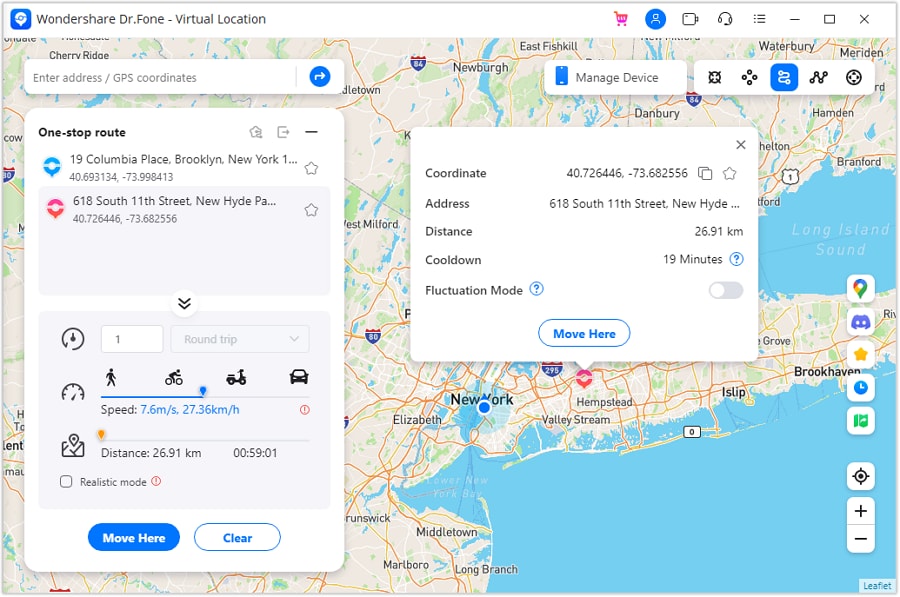
Step 1 Activate a route simulation mode
Open the route feature and choose a mode that matches your plan (for example, a single loop when you’re evaluating a one-zone strategy).
-
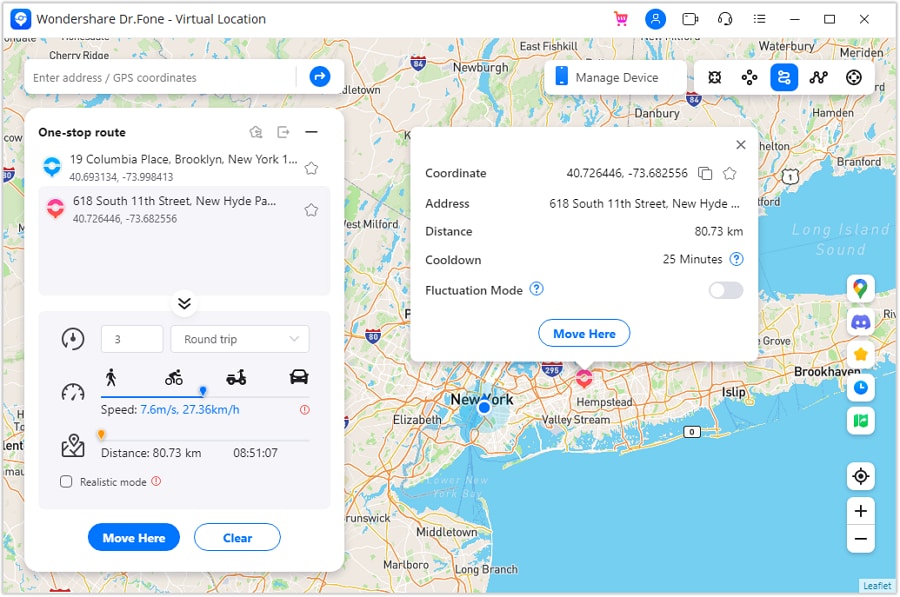
Step 2 Set parameters that reflect your real constraints
Adjust the route and movement parameters (like speed) so the simulation reflects your expected pace and time window.
-
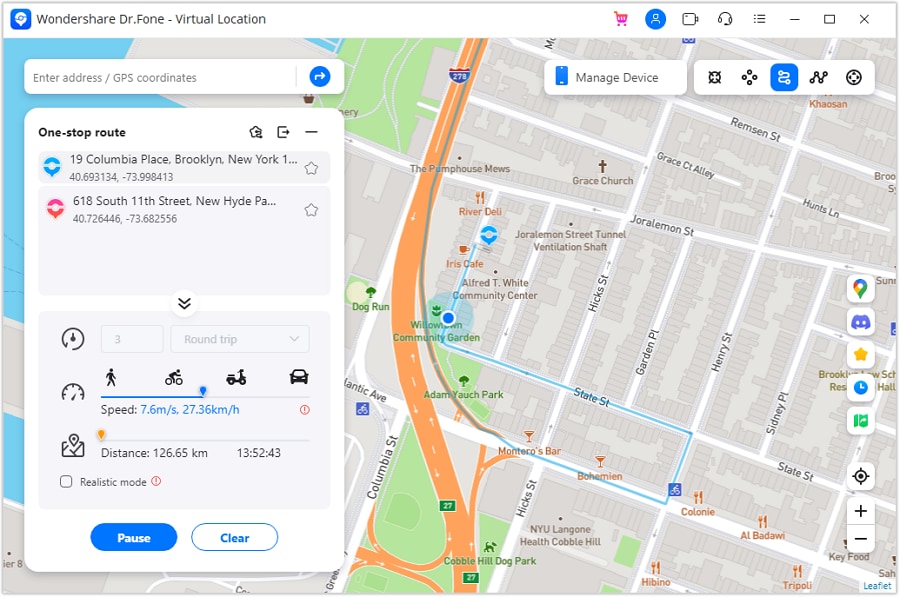
Step 3 Start the simulation and sanity-check the flow
Run the simulation to confirm the route order feels reasonable and doesn’t create excessive backtracking or awkward transitions.
-
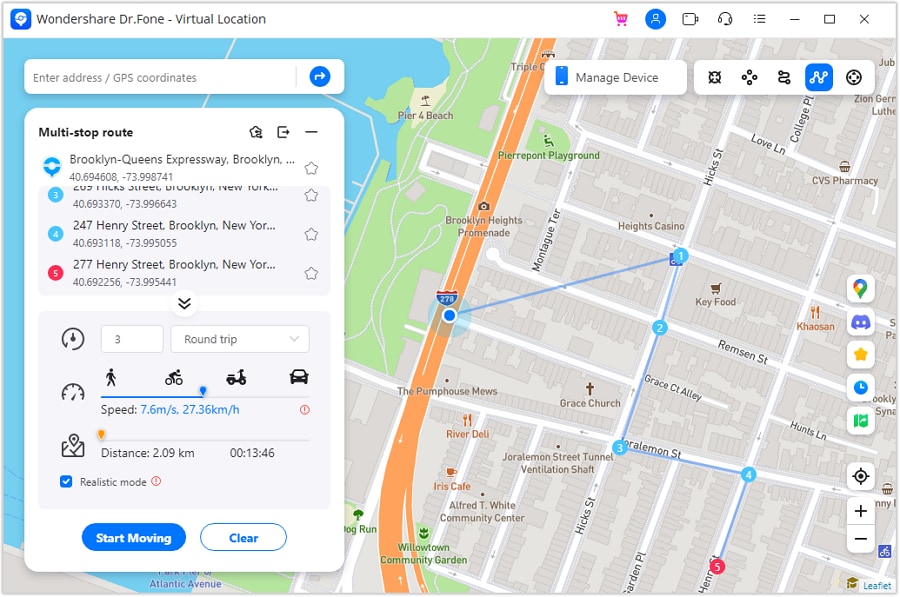
Step 4 Try a multi-stop route to mimic a multi-zone circuit
If you’re evaluating a 3–5 zone circuit, switch to a multi-stop simulation so you can preview context-switching and handoff friction between areas.




Conclusion
AI is best used as decision support to compare route styles and expose trade-offs; real-world use is the final proof, and once you’ve decided, tools like Dr.Fone can help with the practical prep steps (backup, cleanup, transfer) that keep your weekend plan from failing for avoidable reasons.
FAQ
-
Can I trust AI to pick the best multi-zone route?
Trust it to structure trade-offs and highlight risks; don’t trust it to know your on-the-ground realities (signal, crowding, parking, closures) without your input. -
What’s the most important trade-off in multi-zone planning?
Transit time and context-switching versus variety. More zones can feel more fun, but the “hidden tax” is navigation, regrouping, and missed time windows. -
How do I avoid making a spec-like decision (e.g., “most stops per minute”)?
Force a regret test: ask what will annoy you by midday, what makes you quit early, and what breaks group momentum. Then choose the option that avoids your failure mode. -
What should I prepare once I’ve chosen A/B/C?
A time-boxed schedule, one fallback rule, meet-up logistics, and device readiness (battery plan, storage headroom, backup). -
Does switching phones for the weekend change the decision?
Yes—if switching reduces heat/battery anxiety, you can tolerate a more aggressive multi-zone circuit; if switching adds login/transfer friction, a simpler one-zone plan may be safer.
 Add Wondershare Dr.Fone as a preferred source on Google