 Effortlessly manage data through preview, delete, export, etc.

 100% Security Verified | No Subscription Required | No Malware

 :
: 
 ChatGPT
 Perplexity
 Gemini
 Claude
 Grok
Grok
what is attention aware on iPhone? Attention Aware Features is an iOS setting tied to Face ID that uses the TrueDepth camera to detect whether you’re looking at your iPhone. When it’s on, iPhone can keep the display from dimming while you’re paying attention and can adjust certain alert behaviors based on your attention.
In plain English: it helps your iPhone react differently when it "knows" you’re looking at it. One key takeaway: Attention Aware is mainly about convenience and reducing missed info (like the screen dimming too soon or alerts being too loud) without changing your passcode or who can unlock the phone.
In this article
- Part 1. What Attention Aware is used for: core uses & scenarios (Why it matters)
- Part 2. How Attention Aware works: official working logic (How it works, non-technical + technical-lite)
- Part 3. Where to find Attention Aware: settings paths and entry points (Where to find it)
- Part 4. How to use, enable, disable, or check Attention Aware
- Part 5. Requirements and compatibility
- Part 6. Attention Aware vs related concepts
- Part 7. Common issues and misconceptions
- Part 8. Security, privacy, and compliance notes
Part 1. What Attention Aware is used for: core uses & scenarios (Why it matters)
Core uses and real-world scenarios
Attention Aware Features is designed to make everyday interactions smoother by using Face ID’s attention detection to adapt screen and alert behavior when you’re actively looking at the device.
- Your screen stays awake longer while you’re reading, because iPhone detects you’re looking at it.
- Alarm or notification sounds can become less intrusive if you’re already looking at the screen when they arrive.
- You reduce "accidental" screen dimming while following a recipe, article, or directions.
- You get a more natural experience when glancing at the phone during meetings or classes (fewer abrupt brightness/timeouts).
Who needs it most
- Everyday users who find the screen dims too quickly or alerts feel too loud when they’re already engaged with the phone.
- Accessibility-minded users who want the device to respond more intelligently to attention (while still keeping security intact).
- Parents managing a family device, where attention-based behavior can reduce disruptive alert volume in shared spaces.
- Second-hand buyers/sellers who want to verify Face ID-related features are functioning normally during setup and testing.
Part 2. How Attention Aware works: official working logic (How it works, non-technical + technical-lite)
Plain explanation
When Attention Aware Features is enabled, iPhone periodically checks whether your eyes are directed at the screen using the Face ID/TrueDepth camera system. If it detects you’re paying attention, iOS can keep the display from dimming and can adjust certain alert behaviors (such as lowering the volume of some alerts).
Key components
- TrueDepth camera system: provides the sensors Face ID uses to analyze a face and detect attention direction.
- On-device processing: attention detection is handled by iOS during normal use conditions; results influence display/alert behavior.
- Face ID & Passcode permissions: the setting lives alongside Face ID controls and may be unavailable if Face ID isn’t set up.
- Environmental conditions: lighting, obstructions (like coverings over the camera area), and face visibility can affect detection.
- Related toggles: settings like "Require Attention for Face ID" are separate but rely on the same general sensing capability.
Part 3. Where to find Attention Aware: settings paths and entry points (Where to find it)
Settings or menu paths
- iPhone: Settings > Face ID & Passcode > Attention Aware Features
(Some labels can vary slightly by iOS version, but it typically appears in Face ID & Passcode.)
Search keywords and entry tips
- Settings search keyword: "Attention Aware" (also try "Face ID" or "Attention")
- If the label looks different on your iPhone, look for a Face ID-related section that mentions "attention" or "require attention," then check for an "Attention Aware Features" toggle nearby.
Part 4. How to use, enable, disable, or check Attention Aware
Safe how-to steps
-
Step 1 Open Face ID & Passcode
Open Settings, then tap Face ID & Passcode.
-
Step 2 Enter your passcode
Enter your device passcode.
-
Step 3 Toggle Attention Aware Features
Find Attention Aware Features and toggle it On or Off.
-
Step 4 Verify behavior in daily use
Use your iPhone normally and observe whether the screen dims less often while you’re looking at it (and whether alert behavior changes).
Official help resources
Apple’s built-in Tips app and the Settings app descriptions (under Face ID & Passcode) are the safest places to confirm what the toggle does on your specific iOS version.
Part 5. Requirements and compatibility
Quick compatibility table
| Item | What to expect |
|---|---|
| Supported devices/platforms | iPhone models with Face ID hardware (varies by model and iOS version); not available on Touch ID-only iPhones |
| Account sign-in | No Apple ID sign-in is required just to toggle the feature, but Face ID setup typically happens during device setup |
| Required toggles | Face ID must be set up; "Attention Aware Features" must be enabled in Settings |
| Connectivity | Not required for day-to-day function; works offline |
| Offline behavior | Continues working without Wi-Fi/cellular, since it’s a device setting |
| Notable limitations | Can be less reliable in poor lighting, with camera obstruction, or when facial features/eye direction can’t be detected consistently |
Notes and caveats
Exact behavior can differ by iOS version and device model. If Face ID is disabled, not set up, restricted (for example, by Screen Time or enterprise policy), or if the TrueDepth system is not functioning, the Attention Aware toggle may be missing or have limited effect.
Part 6. Attention Aware vs related concepts
Key differences
| Concept | Purpose | Where it appears | Depends on | Common trigger |
|---|---|---|---|---|
| Attention Aware Features | Adjusts screen dimming and some alert behavior when you’re looking at the iPhone | Settings > Face ID & Passcode | TrueDepth + Face ID attention detection | You are (or aren’t) looking at the screen |
| Require Attention for Face ID | Adds an extra check that you’re looking at the device before Face ID unlock/auth works | Settings > Face ID & Passcode | TrueDepth + Face ID | Unlock/auth attempts |
| Raise to Wake | Wakes the screen when you lift the iPhone | Settings > Display & Brightness | Motion sensors | Lifting the phone |
| Auto-Lock | Controls how fast the screen locks when idle | Settings > Display & Brightness | General iOS setting | Time passes without interaction |
When readers confuse them
- "Attention Aware Features" affects display dimming/alerts, while "Require Attention for Face ID" affects Face ID security checks during unlock/auth.
- If your screen dims too fast, Auto-Lock and brightness settings may matter more than Attention Aware.
- If the screen wakes when you pick up the phone, that’s Raise to Wake—not Attention Aware.
Part 7. Common issues and misconceptions
Symptom → likely reason → what to check
- Attention Aware toggle is missing → Face ID isn’t set up or supported on the device → Check whether the iPhone model has Face ID and whether Face ID is enabled in Settings > Face ID & Passcode.
- Feature seems unreliable → TrueDepth camera can’t clearly detect attention (lighting/angle/obstruction) → Clean the top screen area, avoid covering the camera area, and test in normal lighting.
- Screen still dims while reading → Auto-Lock may be set short or attention isn’t consistently detected → Check Settings > Display & Brightness > Auto-Lock, and confirm Attention Aware is enabled.
- Alerts are still loud even when looking → not all alert types behave the same, and Focus/Silent Mode can change expectations → Check Focus settings, Silent Mode, and whether you’re testing with the same alert type each time.
- Face ID-related features behave oddly after an update → temporary iOS glitch or settings reset → Recheck Face ID settings, restart the iPhone, and confirm the toggle state.
When Dr.Fone can help
If Attention Aware or Face ID-adjacent behaviors start acting up after an iOS update, a crash, or a restore, the issue may be broader than one toggle. In those cases, Wondershare Dr.Fone can be relevant for legitimate workflows like iOS system repair, making a backup before troubleshooting, or recovering data after an unexpected restore. It should not be used to bypass security or access a device you don’t own.
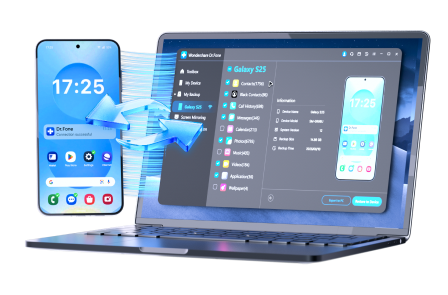
 Effortlessly manage data through preview, delete, export, etc.
- Transfer all data between devices.
- Robust backup solutions for reliable data protection.
- Mirror screens to PC for meetings, teaching, and control.
-
Step 1 Connect iPhone to your computer
Install and open Dr.Fone on a computer, then connect your iPhone with a cable.
-
Step 2 Choose a safe utility
Choose a safe utility such as System Repair or Backup/Restore (depending on whether the issue is stability or data protection).
-
Step 3 Complete the workflow and recheck the setting
Follow the on-screen prompts to complete the selected workflow, then recheck Attention Aware in Settings.
- If you can still access the phone, start with backup and basic iOS troubleshooting (restart, recheck settings) before deeper repairs.
- If you forgot the passcode, use Apple’s official account recovery and device erase methods and ensure you can sign back in with the correct Apple Account.
- If the device is stuck or unstable, system repair and data-protection steps may be appropriate before attempting repeated Face ID setup changes.




Part 8. Security, privacy, and compliance notes
Attention Aware exists to improve usability and, in related Face ID settings, strengthen protection against unintended unlocks or actions when you’re not actively looking at the device. Because it relies on Face ID hardware, you should not try to bypass Face ID, device passcodes, Activation Lock, MDM restrictions, or any ownership protections. If the iPhone is managed by a workplace/school, follow your organization’s IT policy; if ownership or Apple Account access is in question (for example, a second-hand phone), the correct next step is original-owner verification, proof of purchase, and official Apple support channels.
Conclusion
Attention Aware Features on iPhone is a Face ID-linked setting that detects whether you’re looking at your screen to adjust dimming and certain alert behaviors, helping day-to-day usability without changing your core security model. If the setting is missing or behavior becomes unstable after updates or glitches, Dr.Fone may be a reasonable, ownership-respecting option for backup or system repair—alongside Apple’s official troubleshooting paths.
FAQ
Q1. What is Attention Aware on iPhone?
Attention Aware (Attention Aware Features) is an iOS setting connected to Face ID that uses the TrueDepth camera to detect whether you’re looking at your iPhone, then adjusts behaviors like screen dimming and some alert volume behavior accordingly.
Q2. Is Attention Aware the same as "Require Attention for Face ID"?
No. "Require Attention for Face ID" affects whether Face ID will unlock/authenticate only when it detects you’re looking at the device, while "Attention Aware Features" mainly affects display dimming and certain alert behaviors.
Q3. Why can’t I find Attention Aware Features in Settings?
It’s typically available only on iPhones with Face ID hardware and after Face ID is set up. It can also be restricted by Screen Time settings or by enterprise management (MDM), and wording can vary slightly by iOS version.
Q4. Does Attention Aware work without internet?
Yes. It’s a local device setting and does not need Wi‑Fi or cellular data to function during normal use, though Face ID setup and Apple services can require connectivity in other contexts.
 Add Wondershare Dr.Fone as a preferred source on Google


